An AI pilot survives when it has one repeated task, an owner with protected time, two or three measures agreed up front, and a decision date. I use a four-week plan as an example: set up in week one, run in weeks two and three, then keep, kill or expand in week four. Pick a frequent, low-risk task first.
By Johannes Sundlo, AI & Future of Work Advisor. I help leaders and HR teams turn AI into adoption that sticks, through keynotes, workshops and change programs.
An AI pilot needs a defined task, an owner and a decision date. This guide shows how I recommend setting up a trial and assessing whether to continue it.
Why do AI pilots quietly die?
- The test task is disconnected from the team’s daily work.
- There’s no owner with the time and mandate to carry it.
- Success was never defined, so nobody can say if it worked.
- The first rough results get read as “AI doesn’t work here.”
How do you run an AI pilot that leads to adoption?
How do you run an AI pilot that leads to adoption? Choose one repeated task, name an owner with time to run the trial, and agree measures for quality, time and continued use. Put the AI step in the existing workflow and set a review date. The four-week plan below is an example to adapt to the task and its risks. Its interview-summary calculation is illustrative, not a report of measured client results.
One example from my own work. A global industrial group with more than 40,000 employees ran a six-week pilot in Copilot Studio, building HR agents for everything from onboarding to performance reviews. The time the process took was halved. After the pilot the routine was rewritten around the agents, and the money saved went to other work. The pilot had what this article asks for: one defined scope, an owner, a measure and a decision date.
See also the free AI course for HR and the comparison of AI courses for HR professionals.
A pilot that leads to adoption, step by step
- Pick a repeated task. Choose a task with enough repetitions to assess, where errors can be detected and corrected before they affect anyone.
- Name an owner and give them air cover. One person accountable, with protected time and a leader shielding them from ‘prove the ROI by Friday’.
- Define success up front. Pick 2–3 measures: time saved, usage without being told, and whether quality holds. Write them down before you start.
- Build it into the workflow. Put the AI step inside the existing template or checklist, not a separate tool.
- Run it for a few weeks, then decide. Keep, kill, or expand based on the measures, not on vibes or politics.
- Tell the story. Share the concrete result with the rest of the organisation. That is what makes other teams ask for the same thing.
What does the four-week AI pilot plan look like?
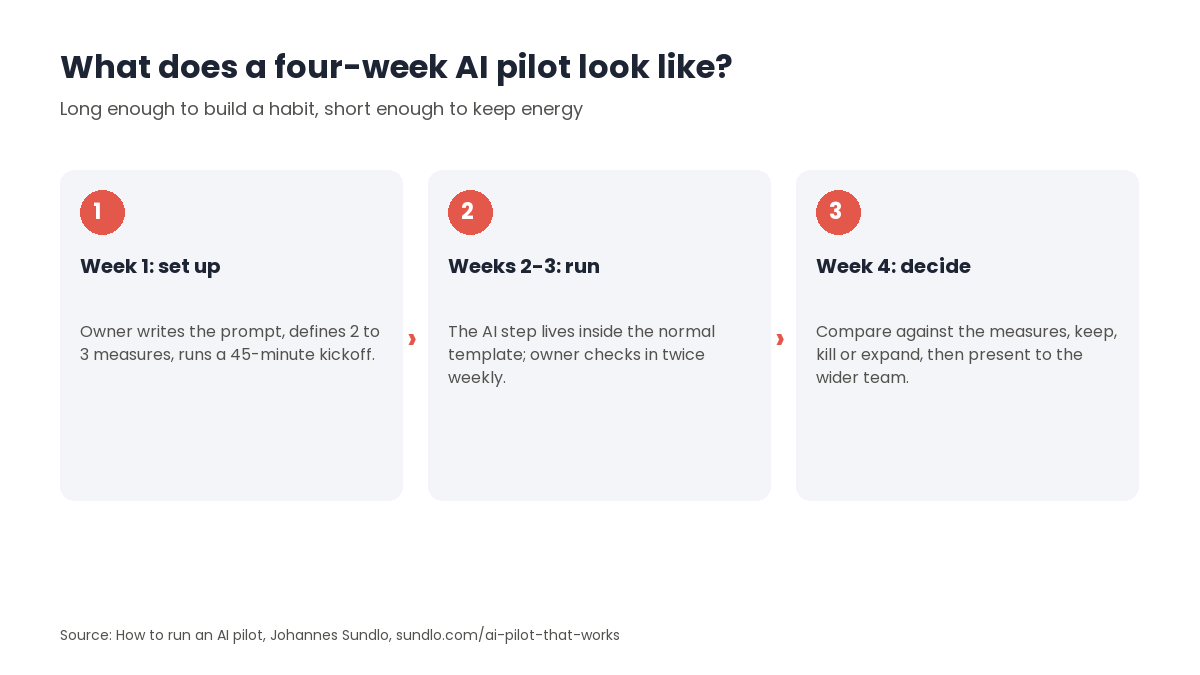
Four weeks can provide an initial review point for a small trial. Adjust the period to the task frequency, risks and preparation needed. For example:
Training needs to be planned alongside the trial. Randstad reported in September 2023 that 13% of more than 7,000 respondents in an international study had been offered AI training in the previous year. That survey does not establish why pilots succeed or fail.
- Week 1, set up. Owner writes the prompt or workflow with the team, defines the 2 to 3 success measures, and runs a 45-minute kickoff where everyone tries it on a real task. Nobody leaves without having used it once.
- Week 2 to 3, run. The AI step lives inside the normal template or checklist. Owner checks in twice a week, collects friction points, and fixes the prompt rather than the people.
- Week 4, decide. Compare against the measures you wrote down. Keep, kill or expand. Then, whatever the outcome, present it to the wider team: what was tried, what the numbers said, what happens next.
Worked example: time spent on interview summaries
This is an illustrative calculation, not a measured client result. Suppose a team completes 40 interview summaries a week and spends 25 minutes on each, including review. Use fictional or appropriately approved material when testing. Human review alone does not make candidate data low risk.
If the total time, including checking and editing, falls to 10 minutes per summary, the saving would be 40 × 15 minutes = 600 minutes, or 10 hours a week. Setup and training time would reduce the net saving. In a pilot, measure these times rather than assuming them. Also check accuracy, missing information and whether people keep using the process. A time saving is only useful if the output meets the agreed requirements.
How do you decide whether to keep, kill or expand an AI pilot?
How do you decide whether to keep, kill or expand an AI pilot? Compare the outcome with the measures agreed before the trial: total time including review, output quality, risks and continued use. Continue if the evidence supports it; adjust or stop if it does not. Expanding needs a separate assessment of ownership, data and support. The 10-hour calculation above illustrates the arithmetic and is not evidence of a result achieved by a client. Share what was tested, the results and the next decision.
How to know your pilot is working
Check whether people continue using the process, whether the output meets the agreed quality criteria and how much checking it needs. Record problems and extra work as well as time saved.
A pilot is step one. For the full system around it, see the hub guide on AI adoption that sticks, plus AI for Leaders on backing pilots from the top.
Common questions about AI pilots
How long should an AI pilot run?
Set an initial review date based on how often the task occurs and how much preparation is needed. Four weeks is an example for a small, frequent task; it is not a universal minimum or a guarantee that a habit will form.
How many pilots should we run at once?
Start with the number you can support properly. One or two may be enough when each trial needs a named owner, practice time and review. Expand when you have evidence and capacity.
What is a good first pilot task?
Something high-frequency, low-risk and disliked: meeting or interview summaries, first drafts of routine documents, structuring free-text feedback. Avoid anything where an error is expensive or a decision about a person is involved.
Plan your first AI pilot
In a workshop we design your first pilots together: task, owner, measures and decision date. A keynote works if you first need to set direction.