My survey of Swedish HR professionals shows employer-provided generative AI rising from 66% in 2024 to 81% in 2025, and respondents reporting an AI policy from 27% to 47%. In 2025, 33% reported formal AI training, and skills and time were the most selected barriers at 41% each. My recommendation: make time for teams to practise on work tasks.
By Johannes Sundlo, AI & Future of Work Advisor. Based on the AI & HR i Sverige survey of Swedish HR professionals (2024: n=257; 2025: n=461).
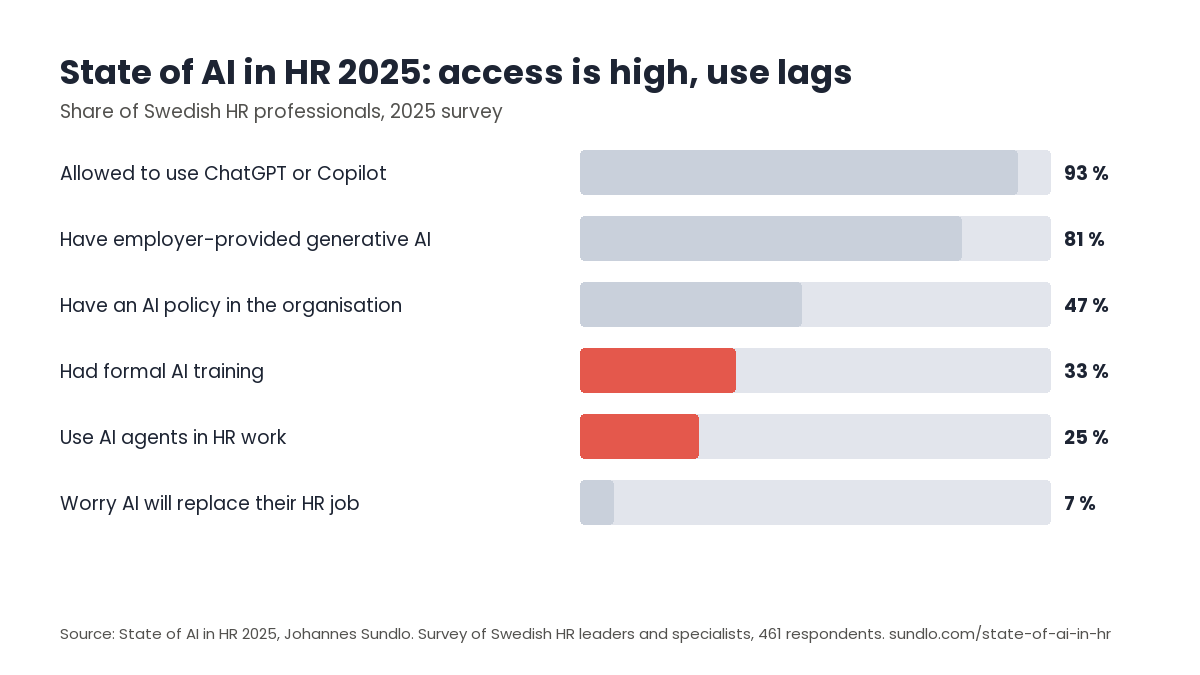
My survey of Swedish HR professionals tracks access to tools, training and AI policies. In 2025, 81% reported employer-provided generative AI, up from 66% in 2024. Separately, 25% reported using AI agents in HR and 33% reported formal AI training. Agent use is a distinct measure and does not represent total AI use.
Key findings (2024 → 2025)
- AI policies nearly doubled: 47% of respondents reported that their organisation had an AI policy in 2025, compared with 27% in 2024. 44% reported no policy in 2025.
- Access surged: 81% have employer-provided generative AI, up from 66%.
- Agents and training: 25% reported using AI agents in HR and 33% reported formal AI training. These measure different things from general AI access.
- Attitudes changed: the share describing themselves as “very positive” was 86% in 2024 and 79% in 2025. The survey does not establish why.
- Job fear stays low: just 7% worry AI will replace their HR job, unchanged across both years.
What does the State of AI in HR survey show?
What does the State of AI in HR survey show? The AI & HR i Sverige survey had 257 Swedish HR respondents in 2024 and 461 in 2025. In 2025, 81% reported employer-provided generative AI, compared with 66% in 2024. Separately, 25% reported AI-agent use in HR and 33% reported formal AI training. Agent use does not measure all AI use. The share reporting an organizational AI policy rose from 27% to 47%. Concern about AI replacing respondents’ own HR jobs remained at 7%. Technical skills and time were the most frequently selected barriers, both at 41%. The results describe the respondents; they do not establish causes or how every Swedish organization works.
See also the free AI course for HR and the comparison of AI courses for HR professionals.
AI policy is catching up, slowly
The share of respondents reporting no organisational AI policy fell from 63% in 2024 to 44% in 2025. The share reporting a policy rose from 27% to 47%. These are responses from the two survey samples, not a measurement of all Swedish organisations or proof of what rules employees followed.
Access, agents and training are different measures
In 2025, 81% reported employer-provided generative AI and 93% said they could use tools such as ChatGPT or Copilot. A quarter reported using AI agents in HR and a third reported formal AI training. These figures describe different parts of organizations’ AI work.
The difference between 81% with access to generative AI and 25% using AI agents does not measure unused licences. The questions concern different things. My recommendation is to track the tasks people use the tools for and the support they need.
Which barriers did respondents report?
The most frequently selected barriers in the 2025 survey were lack of technical skills in the HR team (41%) and not having enough time (41%). Budget was selected by 32%, legal or ethical concerns by 30%, technical limits by 28% and resistance to change by 22%. Respondents could select more than one barrier.
Skills and time are the most frequently selected barriers. I recommend setting aside time to practise on work tasks, reviewing outputs and following up what works. This is a recommendation based on the results, not an effect tested by the survey.
Which AI tools does HR use?
Among respondents to the employer-provided tools question (n=362), Microsoft Copilot leads at 77% and ChatGPT at 49%. Google Gemini was selected by 9% and Claude by 4%. Respondents could select several tools; these figures do not represent market shares across all Swedish HR teams.
How did respondents rate their tools?
Among those answering the effectiveness question, 64% rated their AI tools as effective (13% very and 51% fairly). 23% were neutral and 13% rated them ineffective. These are respondents’ assessments. The question does not establish whether technology, training or other factors explain their experience.
The road ahead
Among respondents to the plans question, 77% reported plans to expand AI use in HR (54% within a year and 23% within two to three years). These were reported plans at the time of the survey, not verified subsequent investments.
Attitudes to AI in the two survey rounds
The share describing themselves as “very positive” about AI in HR was 86% in 2024 and 79% in 2025. The survey does not establish why that share changed or how the same individuals’ views developed. Concern about AI replacing their own HR job was 7% in both rounds.
Whose job is AI, anyway?
In 2024, 6% of respondents framed AI primarily as an HR question, 39% as an IT question and 41% as both. In 2025, the corresponding figures were 3%, 39% and 47%. This question measures how respondents frame the issue, not who holds decision-making authority. My view is that HR should work with leaders and IT on how AI changes tasks, skills and responsibilities.
What it means
The survey shows increased access to generative AI and more organizations with an AI policy. A third of respondents report formal training, while skills and time are common barriers. My recommendation is that leaders practise with the tools themselves, make time for their teams to learn, and follow up use in work tasks.
Want to close the adoption gap in your organisation?
If these numbers look familiar, I work with HR and leadership teams on getting from access to everyday use, through keynotes, workshops and change programs.
Methodology
Figures are from the AI & HR i Sverige survey of HR professionals in Sweden, run by Johannes Sundlo: 257 respondents in 2024 and 461 in 2025. These are two survey rounds; the counts must not be added together as unique people or treated as a panel following the same individuals. Percentages use the people who answered each question. The employer-provided tools question in 2025 had 362 responses and allowed multiple selections. The 2025 survey added questions on AI agents and formal training, so there is no 2024 comparison for those measures. The results describe the respondents and do not establish representativeness or cause and effect. Collection dates and recruitment details are not documented on this page. For practical guidance, see AI adoption that sticks and AI for HR.
How to cite this survey
Suggested reference: Johannes Sundlo, State of AI in HR: Sweden 2024–2025 (AI & HR i Sverige). Research and methodology. Survey samples: 257 responses in 2024 and 461 in 2025.
When quoting a percentage, include the survey year and the measure. The 25% figure concerns AI-agent use in HR, not all AI use. The two sample sizes must not be added together as a count of unique people. For question wording or further methodological details, contact Johannes Sundlo.