Leaders drive AI adoption by creating the conditions rather than buying licences: direction, permission to experiment, guardrails people understand and visible proof. Go first: if you do not use AI, neither will your people. My 90-day plan starts with using AI in your own week and a one-page guardrail on data, then backing two or three real pilots.
By Johannes Sundlo, AI & Future of Work Advisor. I help leaders and HR teams turn AI into adoption that sticks, through keynotes, workshops and change programs.
Buying licences does not change how an organisation works. What changes it is leaders who use the tools themselves, remove the friction and make adoption part of how the place runs. Below is what I recommend leaders do, in what order, and how to lead the change instead of announcing it.
What is your real job as a leader in the AI shift?
You do not have to be the most technical person in the building. Your job is to create the conditions where people can adopt AI safely and fast: a clear direction, permission to experiment, guardrails they understand, and visible proof that it’s worth it. Leaders set the temperature. If you don’t use it, neither will they.
How should leaders drive AI adoption?
How should leaders drive AI adoption? By creating the conditions, not buying licences: a clear direction, permission to experiment, guardrails people understand, and visible proof it is worth it. Your job is not to be the most technical person in the building but to go first: if you do not use AI, neither will your people. My 90-day plan: days 1 to 30, use AI in your own week out loud and write a one-page guardrail on data and when a human must decide; days 31 to 60, back two or three real pilots with air cover and make their wins visible; days 61 to 90, build AI into onboarding, templates and how work gets reviewed. Start with use cases that are high frequency, low risk and clearly owned, then measure breadth, depth and momentum. The trap is confusing access with adoption: in my State of AI in HR survey, 81% of Swedish HR professionals had AI tools but only 25% used AI agents.
An example with a name. At Dafgårds, the family-owned food company, we started with the leadership team and then trained ambassadors. Their rules covered three things: why the company uses AI, how we use it, and what is expected of employees. After 90 days, 99 percent of the leadership team used AI in their work, and several projects that saved thousands of dollars had been started or changed.
See also the free AI course for HR and the comparison of AI courses for HR professionals.
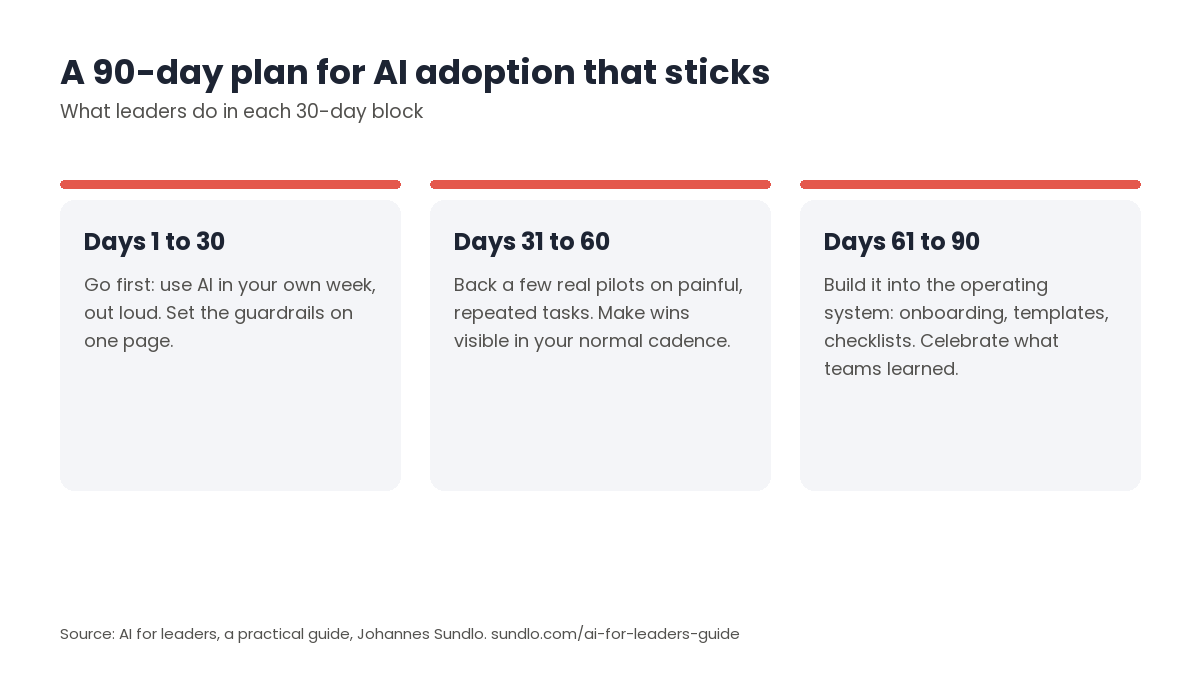
A 90-day plan for AI adoption that sticks
- Days 1–30: Go first. Use AI in your own week, out loud. Share what worked and what flopped. A leader who experiments openly gives everyone else permission to.
- Days 1–30: Set the guardrails. One simple page: what data goes where, what always needs a human, who to ask. Clarity removes the fear that stalls adoption.
- Days 31–60: Back a few real pilots. Pick 2–3 teams with painful, repeatable work. Give them time and air cover, not just a tool. Protect them from “prove the ROI by Friday.”
- Days 31–60: Make wins visible. Surface concrete results in your normal cadence: the all-hands, the team meeting. “This team cut X from a day to an hour” travels faster than any policy.
- Days 61–90: Build it into the operating system. Bake AI into onboarding, templates, and how work gets reviewed. Adoption is permanent when it’s the default path, not a special initiative.
How to decide where AI goes first
Use a simple filter: high frequency, low risk, clear owner. Frequent tasks compound the time savings. Low-risk tasks let people learn without fear. A clear owner means someone carries it through. Plot your candidate use cases on those three and start where all three are green.
Leading the people side of change
- Name the fear. People worry AI replaces them. Be direct: the goal is to remove the boring parts so they do more of the work only humans can. Then make that true.
- Reward learning, not just output. Celebrate the team that tried something and shared what they learned, even when it didn’t work. That’s how a learning culture forms.
- Find your champions. Every team has someone already curious. Give them time, a title, and a stage. Peer proof beats top-down mandates every time.
- Protect focus. Don’t launch ten initiatives. Choose one direction and a few real pilots, then follow them through to a decision.
Which mistakes stall leaders on AI?
- Delegating it entirely. If AI is “IT’s project” or “the innovation team’s thing,” it stays in a corner. It needs a leader who uses it.
- Strategy theatre. A big announcement and a steering committee, but nothing changes in anyone’s actual week. What moves people is watching you use it.
- Punishing early failure. The first AI experiments will be rough. Treat them as material to learn from, not as proof that AI does not work here.
- Confusing access with adoption. Everyone having a licence is not the same as anyone changing how they work. Track behaviour, not seats.
How do leaders handle the people side of AI adoption?
How do leaders handle the people side of AI adoption? Name the fear, reward learning, find champions and protect focus. People worry AI replaces them, so be direct: the goal is to remove the boring parts so they do more of the work only humans can. Celebrate the team that tried something and shared what they learned; that is how a learning culture forms. Every team has someone already curious, so give them time, a title and a stage, because peer proof beats top-down mandates. And do not launch ten initiatives: one clear direction, a few real pilots, relentless follow-through. The numbers put the fear in proportion: in my State of AI in HR survey, only 7% of Swedish HR professionals feared AI would replace their HR job, while the biggest barriers were lack of technical skills at 41% and not enough time at 41%. Avoid the mistakes that stall leaders: delegating AI to IT, strategy theatre, punishing early failure and confusing access with adoption.
How to measure leadership-level progress
Three signals tell you it’s working: breadth (how many teams use AI in real work without being pushed), depth (is it touching meaningful tasks, not just toy ones), and momentum (are new use cases appearing on their own?). When all three trend up, you’ve moved from pilots to a culture.
Get your leadership team aligned and moving
For most leadership teams the technology is the easy part. The hard part is agreeing on a direction and getting the organisation to move. I help with that: keynotes that give your leaders a shared, honest view of AI, and workshops that turn that view into a concrete 90-day plan.
Align your leaders on AI, and move
A keynote sets the direction. In a workshop we build your 90-day adoption plan together. Which one fits depends on where your leadership team is today.
Prefer to start with a conversation? Reach out and tell me what your leadership team is wrestling with.
Common questions about AI for leaders
What is a leader’s role in AI adoption?
To set direction, model the behaviour by using AI yourself, remove friction with clear guardrails, and make wins visible. Leaders set the temperature. If you don’t use AI, your people won’t either. It’s a change-leadership job, not a technical one.
How fast should we move on AI?
Fast on learning, deliberate on scale. In the first 30 days, experiment openly and set simple guardrails. Then back 2–3 real pilots with air cover before baking AI into how work gets done. A 90-day cycle keeps momentum without changing everything at once.
How do I measure AI adoption across the organisation?
Track three signals: breadth (how many teams use it in real work without being pushed), depth (is it touching meaningful tasks, not toys), and momentum (are new use cases appearing on their own?). When all three trend up, you’ve moved from pilots to a culture.
Should leaders learn the tools themselves?
Yes, enough to use AI in your own week and speak about it credibly. You don’t need to be the most technical person in the room, but a leader who experiments out loud gives everyone else permission to. That single behaviour moves adoption more than any announcement.
Related guide: Want the HR-team view? Read AI for HR: a practical guide to adoption that sticks.
Keep reading: AI adoption that sticks · running an AI pilot that doesn’t die.
The data behind this: see the State of AI in HR report, original survey data on the AI adoption gap.
For a programme built around your day-to-day decisions, explore AI leadership training for leaders and managers. For a shared direction across functions, see AI training for executive teams.