The criterion that matters most when choosing an AI keynote speaker is real operating experience: they have helped organisations adopt AI, not only talked about it. Ask for concrete examples, then run through six more questions, from tailoring to handling skeptics and staying current. Brief the speaker on your audience, the outcome you want and the format.
By Johannes Sundlo, AI & Future of Work Advisor. I keynote on practical AI adoption for leaders and HR teams worldwide.
Booking an AI keynote speaker is harder than it looks. The field is crowded with people who can talk about AI but have never helped an organisation adopt it. If you’re choosing a speaker for a conference, leadership offsite, or HR event, here’s how to pick one who leaves your audience with something they’ll use on Monday, not just a slick show.
What makes a great AI keynote speaker?
The best AI speakers share three things: real operating experience (they’ve done the work, not just read about it), a practical, hype-free message, and the ability to make a mixed audience act, not just nod along. Polish matters, but substance and applicability matter more.
How do you choose an AI keynote speaker?
How do you choose an AI keynote speaker? Pick someone with real operating experience, a practical, hype-free message, and the ability to make a mixed audience act, not just nod. Ask seven questions before booking: have they implemented AI or only talked about it; is the talk tailored to your audience; do they sell hype or honesty; what are the two or three practical takeaways; can they handle skeptics and mixed seniority; do they offer more than the talk, such as workshops; and what have they changed their mind about in the last year. Red flags: a beautiful deck with no real example, one generic talk for every audience, predictions and fear without a path forward, no track record of changing how teams work. Fees vary by experience, audience and format, so ask for a tailored proposal. My own keynotes on AI adoption pair strategy with practice, draw on my State of AI in HR survey, and start at 20 000 SEK excluding VAT and travel.
See also the free AI course for HR and the comparison of AI courses for HR professionals.
7 questions to ask before you book
- Have they implemented AI, or only talked about it? Ask for concrete examples of adoption they’ve driven inside organisations.
- Is the talk tailored to your audience? A keynote for HR leaders should sound different from one for a tech crowd. Ask how they adapt.
- Do they sell hype or honesty? Great speakers name what AI can’t do yet. Be wary of pure utopia (or pure doom).
- Will the audience leave with something to do? Ask what the 2–3 practical takeaways are. Inspiration that fades by lunch isn’t worth the fee.
- Can they handle the room? Q&A, skeptics, mixed seniority. Ask for references or video.
- Do they offer more than the talk? A speaker who also runs workshops can turn a keynote into lasting change.
- Are they current? AI moves monthly. Ask what they’ve changed their mind about in the last year.
What are the red flags to avoid?
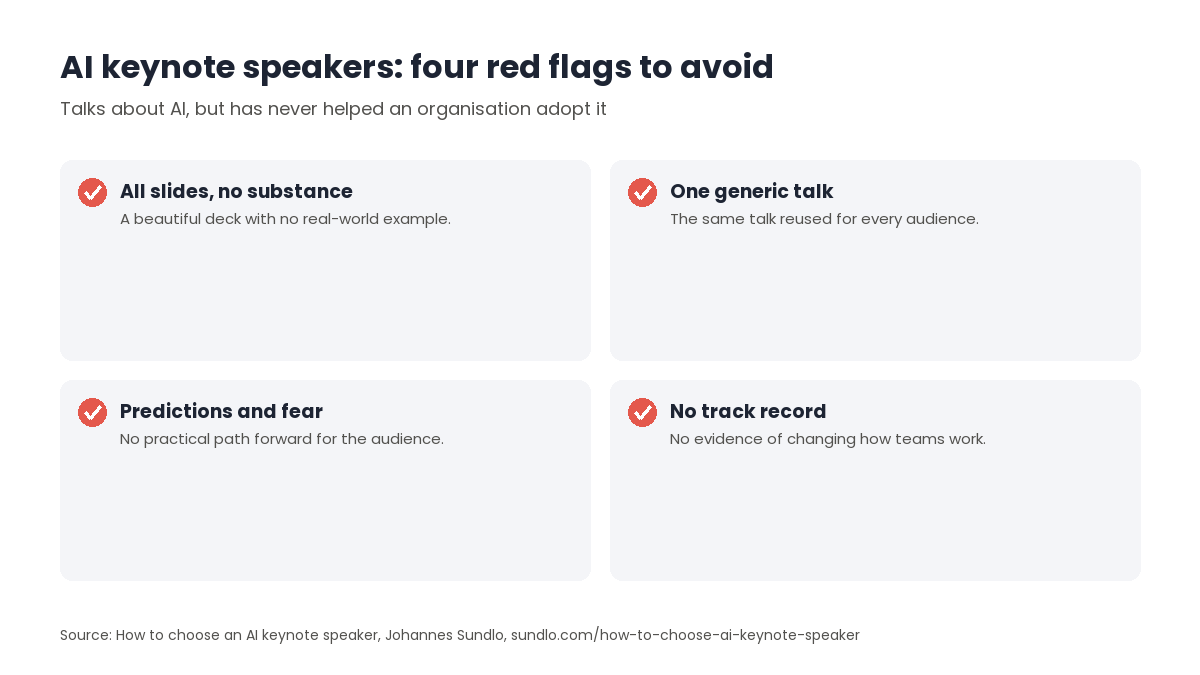
- All slides, no substance: a beautiful deck with no real-world example.
- One generic talk reused for every audience.
- Predictions and fear, but no practical path forward.
- No track record of changing how teams work.
How do you brief an AI keynote speaker and choose the format?
How do you brief an AI keynote speaker and choose the format? Share three things: your audience (roles, seniority and AI maturity), the outcome you want, and the format. A good speaker then tailors the talk to that. On format, a keynote sets direction and inspires action for a large audience, while a workshop turns that into hands-on skills and a plan for a smaller group; the strongest engagements pair both, a keynote to align and a workshop to build. Be honest about maturity: in my State of AI in HR survey, only 33% of Swedish HR professionals had formal AI training, so most rooms mix curious beginners with skeptics. Ask the speaker to cover why most AI initiatives stall, what leaders and HR should do in the next 90 days, honest limits, and real examples grounded in data. That is how I build my own keynotes, including at UNLEASH and HR Technology Europe, and why I pair them with workshops.
What topics should a strong AI keynote cover?
- Why most AI initiatives stall, and the conditions that make adoption stick.
- What leaders and HR specifically should do in the next 90 days.
- Honest limits: where AI helps, where it backfires.
- Real, current examples grounded in data, not vendor decks.
For a sense of the substance behind a good AI-in-HR keynote, see the original research in the State of AI in HR report and the practical frameworks in AI adoption that sticks.
Common questions
How much does an AI keynote speaker cost?
Fees vary widely by experience, audience and format. My own keynotes start at 20 000 SEK excluding VAT and travel. Before you compare prices, decide what you want the audience to do afterwards; a cheaper talk that is forgotten by Monday is the expensive option. Ask for a tailored proposal.
What’s the difference between a keynote and a workshop?
A keynote sets direction and inspires action for a large audience; a workshop turns that into hands-on skills and a plan for a smaller group. The strongest engagements often pair both: a keynote to align, a workshop to build.
How do I brief an AI keynote speaker?
Share your audience (roles, seniority, AI maturity), the outcome you want, and the format. A good speaker adapts the talk to that. Say how far the audience has come with AI; most rooms mix beginners and skeptics.
Looking for a practical AI keynote speaker?
My keynotes are about AI adoption, built on my own survey data and adapted to the room. Tell me about your event and audience and I will come back with a proposal.
Ready to compare names? See 12 AI keynote speakers for HR conferences in 2026, with published fee ranges.