The short answer
AI can automate parts of HR work and may change or reduce some roles. That is not the same as replacing the whole HR function, and no one can guarantee an individual job is safe. The practical response is to learn which tasks AI can support while strengthening judgment, relationships and accountability.
Read the full guide- More exposed Routine drafting, summaries and administration.
- Still accountable People decisions, context and relationships.
- Your next step Learn a workflow and show the value you add.
What is the honest near-term picture?
The pattern I see across functions, not only HR, is consistent: AI automates tasks, then roles get rearranged around the tasks that remain. Wholesale elimination of entire professions is rare and slow. The reshaping of how a job is done is fast and already happening.
For HR specifically, this means the day-to-day mix of work shifts. The parts of your job that are repetitive, text-heavy, and rules-based are the first to move to AI. The parts that require reading a room, weighing competing interests, and standing behind a hard decision do not move at all. If anything, they get more important.
AI is very good at producing a first draft of almost anything. It is poor at owning the consequences of a decision. HR lives in the consequences.
Will AI take HR jobs?
Will AI take HR jobs? AI will take a meaningful share of HR tasks, not the HR function. Across professions, AI automates tasks and roles are rearranged around what remains; wholesale elimination of a profession is rare and slow. In HR, the work most exposed is drafting and templating, first-pass screening, tier-one employee questions, summarising and scheduling. The work that grows in value is judgment under ambiguity, ethics and accountability, relationships and trust, and leading change. No one can guarantee an individual job is safe: a role defined almost entirely by processing transactions is at risk because the tasks shrink and expectations rise. Fear is lower than the headlines suggest: in my State of AI in HR survey of Swedish HR professionals, 7% fear AI will replace their HR job, while Gallup found 45% of US employees already use AI at work. The practical response is to use the tools on real work this week and shift your hours toward judgment.
See also the free AI course for HR and the comparison of AI courses for HR professionals.
What AI will genuinely automate in HR
Be honest with yourself about how much of the week is already automatable. A large share of HR work is structured language and structured data, which is exactly where current AI is strong.
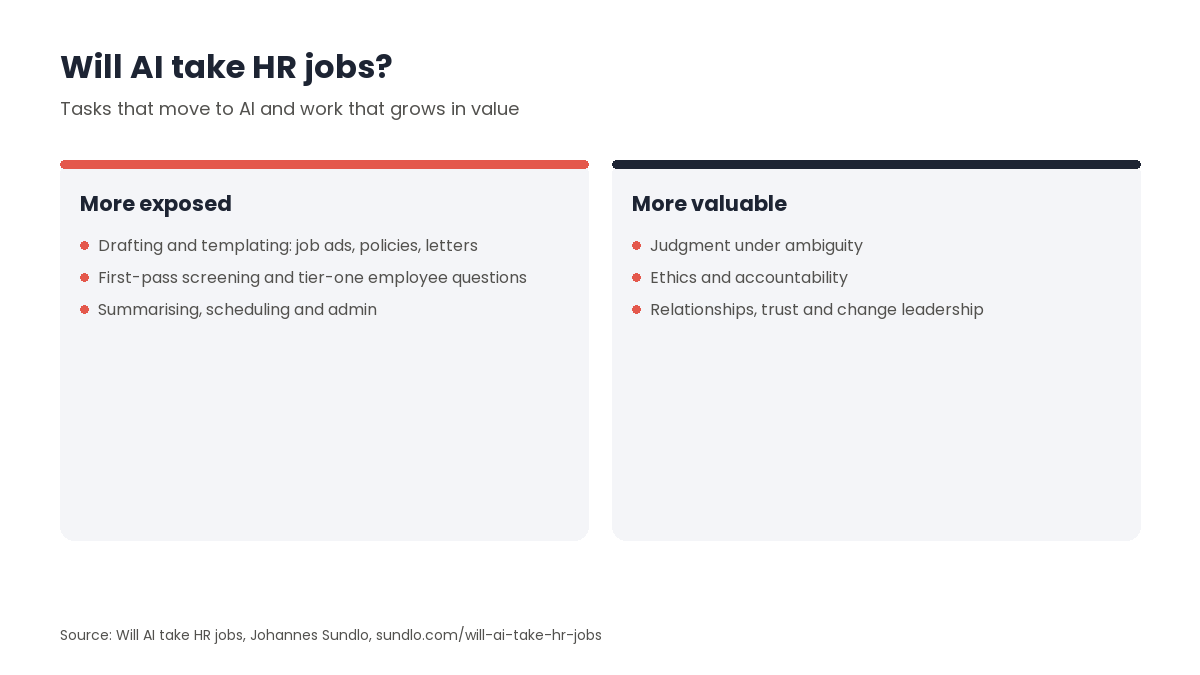
- Drafting and templating. Job descriptions, interview guides, policy first drafts, offer letters, internal announcements, FAQ responses.
- Screening and sorting. First-pass CV review against clear criteria, candidate ranking support, surfacing patterns in large applicant pools.
- Employee questions. Tier-one queries about leave, benefits, policy, and process that today eat hours of inbox time.
- Summarising and synthesising. Turning engagement survey comments, exit interviews, or meeting notes into themes.
- Scheduling and admin. Coordination, reminders, status tracking, and the long tail of small tasks that fragment a day.
Automating these tasks can free time, change expectations or reduce the work required in a role. Whether that ends in job loss or job security depends on how the organisation uses the freed capacity, and nobody can promise either.
What becomes more valuable, not less
The fear narrative skips what happens next. When the routine work moves to AI, the human work that is left is the work that was always the hardest to do well. That work becomes the core of the job rather than the thing you squeezed in between admin.
Judgment under ambiguity
AI can tell you what a policy says. It cannot decide whether to make an exception for a grieving employee, or how to balance fairness to one person against precedent for everyone else. Judgment in messy, high-stakes situations stays human.
Ethics and accountability
Someone has to be answerable for decisions about people: pay, promotion, performance, dismissal, and the use of AI itself in those decisions. Accountability cannot be delegated to a model. As AI enters more people-decisions, HR becomes the function that has to ask whether a tool is fair, explainable, and lawful.
Relationships and trust
People bring HR their hardest moments: conflict, burnout, harassment, a manager who has lost the room. Those conversations depend on trust built over time. A chatbot does not hold trust. You do.
Change leadership
Organisations are about to go through significant change, partly driven by AI itself. Guiding people through uncertainty, communicating honestly, and keeping a culture intact under pressure is leadership work. It is squarely in HR’s lane and it is growing.
Which HR skills become more valuable as AI automates routine work?
Which HR skills become more valuable as AI automates routine work? Four kinds of work grow in value as drafting and screening move to AI: judgment under ambiguity, ethics and accountability, relationships and trust, and change leadership. AI can tell you what a policy says; it cannot decide whether to make an exception for a grieving employee or balance fairness against precedent. Someone has to be answerable for decisions about pay, promotion, performance and dismissal, and for whether any AI tool involved is fair, explainable and lawful. People bring HR their hardest moments, from conflict to burnout, and a chatbot does not hold trust. Leading people through AI-driven change is squarely HR’s work. Invest deliberately in coaching, facilitation, negotiation and difficult conversations, because those compound. In my State of AI in HR survey, 77% of Swedish HR professionals plan to expand AI in HR, so the reshaping is coming; use the tools well and spend the reclaimed time on work only a person can do.
So is your specific job safe?
Let me be balanced rather than comforting. If your role is defined almost entirely by processing transactions, and you treat AI as something happening to other people, then yes, that version of the role is at risk. Not because a robot replaces you, but because the tasks shrink and the expectations rise.
If you move up the value chain, toward judgment, advice, ethics, and leading change, the demand for what you do increases. Resisting AI protects no one; the skill that protects you is using it better than the alternative and spending the reclaimed time on work only a person can do.
What should HR people do now?
This is the practical part, and none of it requires a technical background. It requires fluency with the tools and a deliberate choice about where your hours go.
- Use the tools on real work this week. Pick one recurring task and run it through AI. A job description, a survey summary, a policy draft. You learn more from one real attempt than from ten articles.
- Build basic literacy. Understand what these tools are good at, where they fail, and how they handle sensitive data. If you want a structured starting point, my AI literacy playbook walks through it.
- Audit your week. List your tasks and mark which are automatable and which need human judgment. Aim to shift your hours toward the second category.
- Own the governance question. If AI is going to influence hiring, performance, or pay in your organisation, HR should be in the room shaping how, not finding out afterward.
- Double down on the human skills. Coaching, facilitation, negotiation, and difficult conversations are the things that compound in value. Invest in them deliberately.
- Reframe your role to your leadership. Move the conversation from administrator to advisor, because the teams that do this get budget and trust.
If you want a broader view of where this is heading and how the function is changing, I keep a running perspective on AI for HR that goes deeper than any single article can.
The bottom line
Will AI take HR jobs? It will take a meaningful chunk of HR tasks, and that is a good thing if you let it free you up. What it will not take is the judgment, the ethics, the relationships, and the leadership that make HR matter. Those are becoming the job, not a side note to it.
The people at risk are the ones who stand still while the role moves around them. Running one real task through AI this week is how you avoid being one of them.
Sources
Put one hour into practice
Practical AI for HR, at your own pace. Free, with a certificate of completion.