The short answer
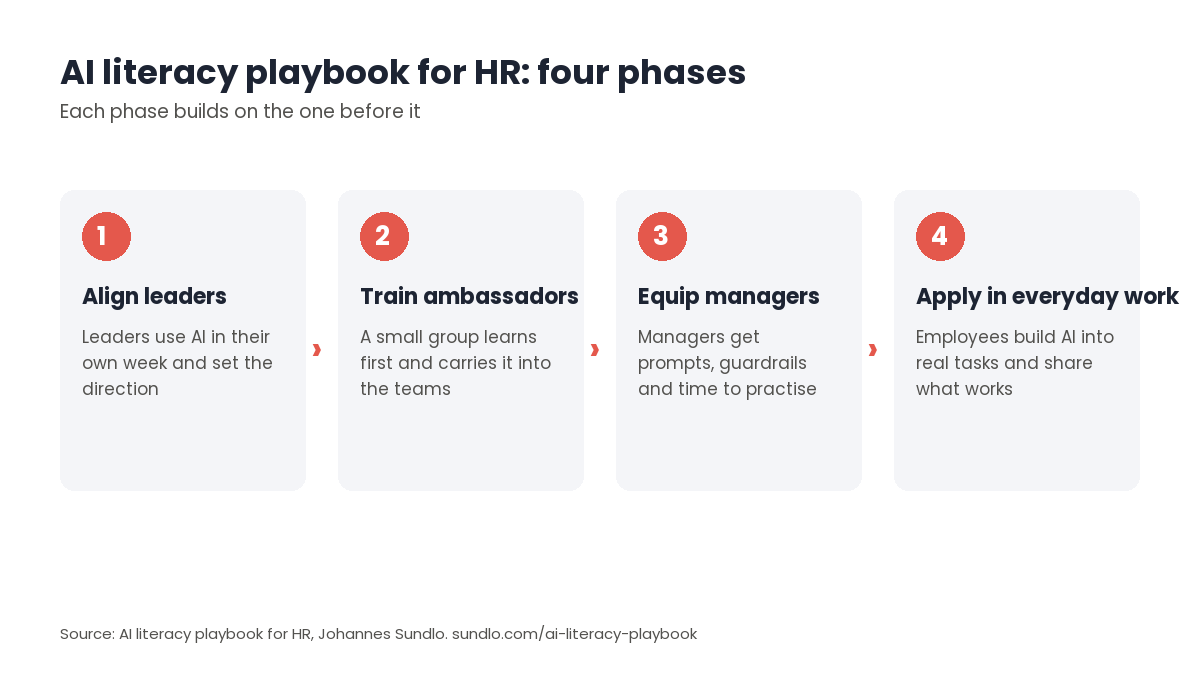
A useful AI literacy programme connects learning to real work. My four-phase approach starts with leadership alignment, develops internal trainers, equips managers and then supports teams with practical use cases. Define success and data boundaries early, and measure what changes after the training rather than counting attendance alone.
Read the full guide- Start with leaders Agree the purpose and evidence of progress.
- Build local support Train ambassadors and managers.
- Practise at work Give each team a repeatable use case.
Phase 1, Leadership alignment & defining success
Before anyone is trained, leadership gets hands on the tools themselves and agrees on two things: why AI matters here, and what success looks like in numbers. Skip this and every later phase drifts, because no one can say whether it is working.
- Executives use the tools directly, no delegating the understanding.
- Agree a shared narrative for why this matters to your business.
- Define success metrics up front (time saved, quality, adoption rate).

What is an AI literacy playbook for HR?
What is an AI literacy playbook for HR? An AI literacy playbook is a staged plan for teaching an organisation to use AI in real work, and mine has four phases. Phase 1: leadership gets hands on the tools, agrees why AI matters here and defines success in numbers such as time saved, quality and adoption rate. Phase 2: 10 to 15 internal AI ambassadors from different functions get intensive, multi-week training so they can scale instruction. Phase 3: managers learn by doing and get simple principles for encouraging use with sensible boundaries. Phase 4: the ambassadors train the wider organisation and every team commits to one or two documented use cases. The order matters because it gives the programme direction, local support and space to practise. The need is real: in my State of AI in HR survey of Swedish HR professionals, 81% have employer-provided generative AI but only 33% have had formal AI training. Measure what changes after the training, not attendance.
See also the free AI course for HR and the comparison of AI courses for HR professionals.
Dafgårds, the family-owned food company, ran the phases in this order: leadership team first, then ambassadors, with rules covering why the company uses AI, how we use it and what is expected of employees. After 90 days, 99 percent of the leadership team used AI in their work, and several projects that saved thousands of dollars had been started or changed.
Phase 2, Train the trainers
You cannot train a whole organisation from the centre, and you should not try. Select 10–15 internal AI ambassadors from across functions and give them intensive, multi-week training. They become the people who scale instruction, and, more importantly, the trusted local face of it.
- Pick ambassadors who represent different parts of the org, not just IT.
- Invest deeply in this small group, they multiply your reach.
- They carry context the central team never could.
Phase 3: How do you enable managers?
Managers make or break adoption. If a manager is anxious about risk, the team will not touch the tools; if a manager models use, the team follows. This phase gets managers using AI themselves and gives them simple principles for guiding their team without blocking experimentation.
- Managers learn by doing, not by reading a policy.
- Equip them to encourage use and hold sensible boundaries.
- The goal is permission with guardrails, not fear.
How do you choose and train internal AI ambassadors?
How do you choose and train internal AI ambassadors? Select 10 to 15 people from across functions, not just IT, and give them intensive, multi-week training so they can scale instruction. You cannot train a whole organisation from the centre, and you should not try; a small, representative group multiplies your reach and carries context the central team never could. Invest deeply in them, because they become the trusted local face of AI rather than an outside voice. Their job in the final phase is to train the wider organisation and help every team commit to one or two concrete, documented use cases; documentation turns a one-off “that was cool” into a repeatable habit other teams can copy. The need is real: in my State of AI in HR survey of Swedish HR professionals, 41% name lack of technical skills and 41% not enough time as barriers. Managers still matter: if a manager models use, the team follows.
Phase 4, Employee training & real use cases
Now the broader organisation gets trained, ideally by those internal ambassadors, not an outside voice, and every team commits to one or two concrete, documented use cases. Documentation matters: it turns a one-off “that was cool” into a repeatable habit other teams can copy.
- Train through internal ambassadors for trust and context.
- Each team ships one or two real, documented use cases.
- Use cases become the proof and the playbook for the next wave.
Why does the order matter?
Leaders give it direction, ambassadors and managers give local support, and team use cases give practice. Treat the phases as a working framework, not a universal rule: adapt the pace and overlap to your organisation.
And this is foundational literacy rather than the finish line. Agents, deeper integration and new ways of working all get built on this floor, which is why it comes first. If the vocabulary in here is shaky for any group, start them with the AI dictionary for HR. For the leadership-specific view, see the AI guide for leaders.
Sources
Make it useful for your team
Start with your real tasks, the tools you can use and what you want people to do afterwards.