The short answer
Build AI capability in HR by learning the basics, practising clear prompts and turning one useful task into a repeatable workflow. Use an approved tool and set data rules before practising. A course can get you started; regular use, review and sharing with colleagues turn that knowledge into a working habit.
Read the full guide- Learn the basics Know the limits as well as the possibilities.
- Practise one task Repeat, review and improve it.
- Share the learning Prompts, examples and mistakes worth avoiding.
Why should HR own AI upskilling?
If HR does not build its own AI knowledge, two things happen. First, the function becomes a bottleneck on policy questions it cannot answer with confidence. Second, decisions about AI at work get made without an HR voice in the room. Upskilling is how you keep a say in those decisions, and how you protect employees from sloppy or unfair use.
You are also the natural owner of the human side: fairness, transparency, data handling and what happens to roles. That has always been HR work, and AI only changes the tools you do it with.
How should HR upskill in AI?
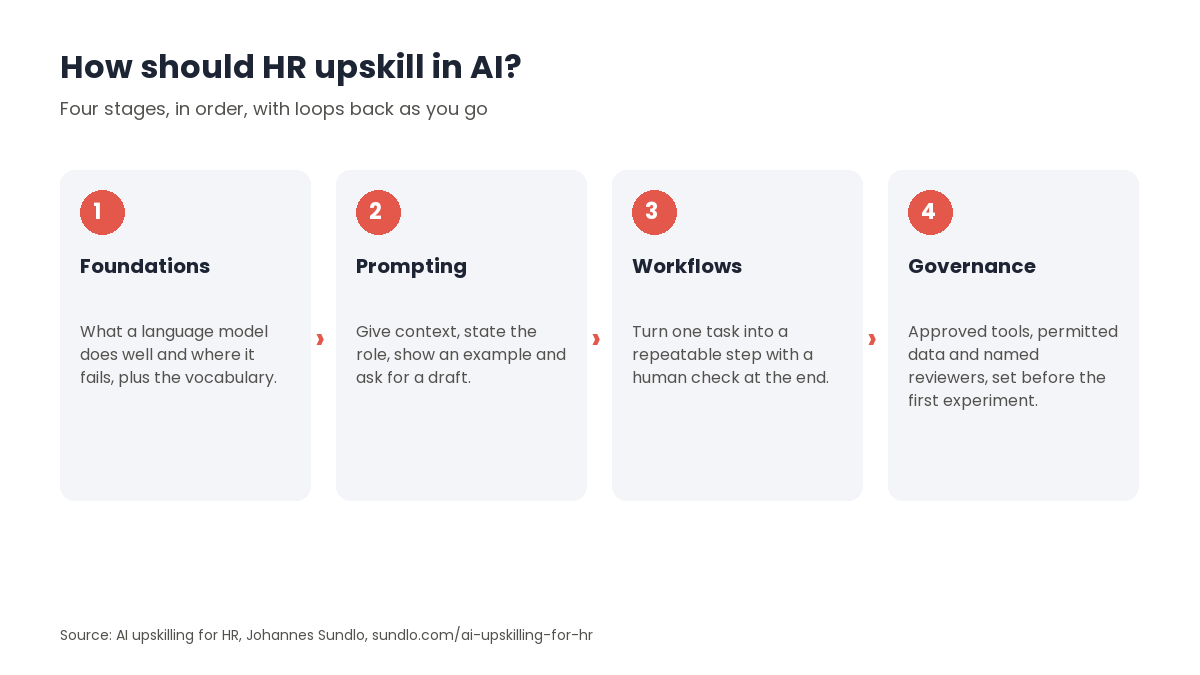
How should HR upskill in AI? Build AI capability in HR in four stages: foundations (what a language model does well and where it fails), prompting (brief it with context, a role and an example), workflows (turn one task into a repeatable step with a human check at the end) and governance (approved tools, permitted data and named reviewers). Use an approved tool and set data rules before you practise. Then pick one real task, such as summarising interview notes or drafting a job ad, and do it with AI every working day for two weeks; the habit teaches you the edges no course can. Spread it by sharing prompts that work, running short regular sessions and naming an owner. In my State of AI in HR survey of Swedish HR professionals, only 33% have had formal AI training and 41% cite lack of technical skills. My free 60-minute AI course for HR is a starting point; the daily habit is what makes it stick.
See also the comparison of AI courses for HR professionals and AI keynote speakers for HR.
A simple four-stage progression
Treat your learning as four stages. Move through them in order, but expect to loop back as you go.
1. Foundations
You do not need to understand the maths. You do need a working mental model: what a large language model is, what it is good at (drafting, summarising, structuring, comparing), and where it fails (facts it invents, recent events, anything requiring true judgement). Learn the vocabulary so you can read a vendor contract or a policy without getting lost. My AI dictionary for HR covers the terms you will meet most often.
- What is a model, a prompt, a token, a hallucination.
- The difference between a chatbot and a tool built into your HR system.
- Why data privacy and where you type things matters.
2. Prompting
Prompting is the core skill, and it is closer to delegation than to coding. You are briefing a capable but literal assistant. The habits that work: give context, state the role, show an example of the output you want, and ask for a draft you can refine rather than a finished answer.
- Tell it who it is writing for and in what tone.
- Paste in your own material (a job spec, a policy, notes) so it works from your facts, not its guesses.
- Iterate. The second and third prompt usually beat the first.
3. Workflows
A single prompt saves minutes, while a workflow saves hours because you stop rebuilding it each time. Here you connect AI into a repeatable task: screening notes into a structured summary, interview questions from a competency framework, a first draft of a survey analysis. The goal is a step you run the same way every time, with a human check at the end.
4. Governance
Set basic rules before the first experiment: which tools are approved, what data can be used and who reviews outputs. As use grows, strengthen ownership, documentation and review for decisions that affect people.
Why build the habit before the expertise?
Knowledge fades if you do not use it. The single most effective thing you can do is decide on one task you will do with AI every working day for two weeks. Drafting a response, summarising a meeting, rewriting a clunky policy paragraph. It does not matter which, as long as it is real and you keep at it.
A habit beats a course because it forces you to learn the edges: when the output is wrong, when it saves real time, when it is faster to do it yourself. That judgement is the skill that matters, and you only get it by doing the work.
Learn on real HR tasks
Skip the toy exercises and use AI on work that is already on your desk. Some starting points that usually pay off:
- Turn messy interview notes into a structured candidate summary.
- Draft a first version of a job ad from a short brief, then edit for voice.
- Summarise an engagement survey’s free-text comments into themes.
- Rewrite a policy in plain language for the employee handbook.
- Prepare questions for a difficult conversation, then pressure-test your own approach.
In every case, you stay the decision-maker. AI produces the draft; you bring the context, the fairness check and the final call.
Spread it across the team
Personal upskilling is the start. The bigger win is lifting the whole function. A few things make this stick:
- Share prompts that work. Keep a simple shared document of prompts and examples your team can copy. This is the fastest way to level people up.
- Run short, regular sessions. Thirty minutes where two colleagues show one thing they did with AI beats an annual training day.
- Name an owner. Someone should track which tools are approved, answer questions and keep the light governance current.
- Make it safe to be a beginner. People learn faster when they can admit what they do not know.
If you want a structured way to roll this out across your organisation, my AI literacy playbook lays out the stages, the roles and the artefacts you will need.
How do you spread AI skills across an HR team?
How do you spread AI skills across an HR team? Spread AI skills across an HR team with four habits: share the prompts that work, run short regular sessions, name an owner and make it safe to be a beginner. A simple shared document of prompts and examples that colleagues can copy is the fastest way to level people up. Thirty minutes where two colleagues show one thing they did with AI beats an annual training day. The owner tracks which tools are approved, answers questions and keeps the light governance current. And people learn faster when they can admit what they do not know. Regular use is still the exception: Gallup’s Q3 2025 survey of 23,068 US employees found 23% use AI a few times a week or more and only 10% daily. Personal upskilling is the start; lifting the whole function is the bigger win. For a structured rollout across your organisation, my AI literacy playbook lays out the stages, roles and artefacts.
Where to start this week
Pick one task and use AI on it every day for two weeks. Read up on the terms when you hit one you do not know, keep a note of what worked and show it to a colleague. That is the entire method, and it is enough to become good at this; the expertise comes out of the habit.
Sources
Put one hour into practice
Practical AI for HR, at your own pace. Free, with a certificate of completion.