The short answer
Ethical AI in HR means making fairness, privacy, transparency and accountability part of everyday decisions. Keep an inventory of AI uses, assess the risks, name a human owner and provide a way to question outcomes. Hiring, pay and performance decisions need more scrutiny than a draft of a routine message.
Read the full guide- Know what is used A tool, purpose, data source and named owner.
- Check the risk Who could be harmed, and how?
- Make review real People need time and authority to intervene.
Which principles matter?
Most ethical AI frameworks land on the same five ideas. You do not need to memorise a standard to use them, but you do need to know what each one asks of you in plain terms.
- Fairness and bias. The system should not disadvantage people based on protected traits like gender, age, ethnicity, or disability. Models learn from past data, and past hiring data often carries old patterns. Without checks, the tool repeats them at scale.
- Transparency. People affected by a decision should be able to understand, in everyday language, that AI was involved and roughly how it works. Candidates and employees do not need the source code. They do need an honest account.
- Privacy. Collect the minimum personal data the task needs, use it only for that purpose, and protect it. AI makes it tempting to feed in everything you have, so decide up front which fields stay out.
- Human oversight. A person stays accountable for the outcome and can intervene, override, or reject the system’s output. The AI advises, and someone with the authority to say no decides.
- Accountability. Someone owns each AI use case by name. When a decision is questioned, there is a clear answer to “who is responsible and how do we review this.”
What is ethical AI in HR?
What is ethical AI in HR? Ethical AI in HR means making fairness, privacy, transparency, human oversight and accountability part of everyday people decisions, with hiring, pay and performance getting more scrutiny than a routine draft. In practice it comes down to six habits: keep an inventory of every AI tool touching HR decisions, with a named owner; run a quick risk check before adoption; demand bias-testing evidence from vendors; define a human checkpoint with the authority and time to override; tell candidates and employees when AI is involved and give them a route to contest; and review high-risk tools on a schedule, because models drift. The EU AI Act classifies AI used in employment, worker management and recruiting as high-risk and restricts workplace emotion recognition. Governance is catching up slowly: in my State of AI in HR survey, 47% of Swedish organisations have an AI policy, up from 27% in 2024. Write it as one short policy page, not a manual.
See also the free AI course for HR and the comparison of AI courses for HR professionals.
How the principles apply to real HR uses
Hiring and screening
This is where the risk is highest, because the stakes for the individual are high and the volume is large. A resume screener trained on past hires can quietly favor the profiles you already employ. Before you trust a tool, ask the vendor how it was tested for bias across groups, and ask to see the results. Keep a human reviewing borderline and rejected candidates rather than auto-filtering, and tell applicants when AI is part of the process. None of this slows good hiring, and it is what lets you explain a rejection when a candidate asks.
Performance management
AI can summarize feedback, surface patterns, and draft reviews. It should not assign a rating on its own. Performance touches pay, promotion, and exits, so the manager owns the judgment and can explain it without pointing at a score. Use AI to reduce the busywork around reviews, not to outsource the verdict.
Workplace monitoring
Productivity and activity tracking is the area most likely to erode trust. The test is proportionality: is what you measure necessary for a legitimate purpose, and do people know about it. Continuous surveillance dressed up as analytics tends to fail both the legal and the cultural test. Be specific about what you track, why, and for how long, and tell people plainly.
A short governance set HR can adopt
You do not need a committee of twelve, only a few habits that hold up when an employee or a regulator asks questions. This is the operational core of AI adoption that holds up in daily use.
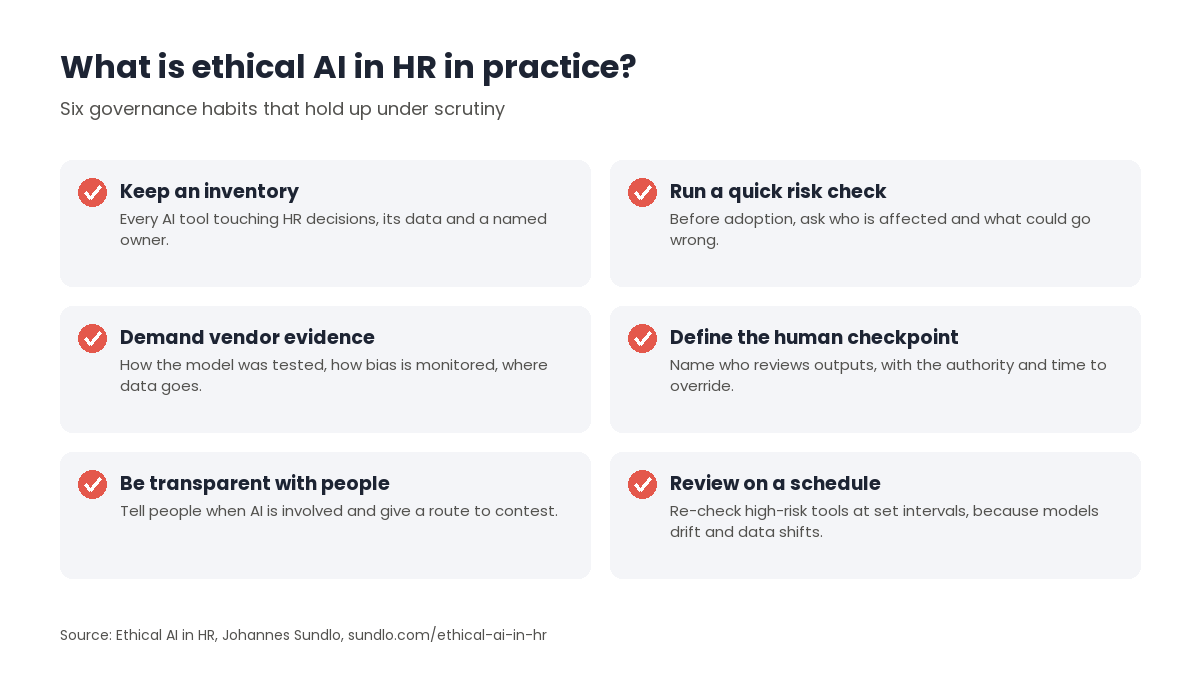
- Keep an inventory. List every AI tool touching HR decisions, what it does, what data it uses, and who owns it. Without that list, nobody can say which tools touch a hiring decision.
- Run a quick risk check before adoption. For each use, ask who is affected, what could go wrong, and how a person can step in. High-stakes uses like hiring get more scrutiny than a meeting-notes summarizer.
- Demand evidence from vendors. Ask how the model was tested, what data it was trained on, how bias is monitored, and where your data goes. A serious vendor has answers. Put the key ones in the contract.
- Define the human checkpoint. For each use, name who reviews outputs and when, and make sure they have the authority and time to override.
- Be transparent with people. Tell candidates and employees when AI is involved and give a route to ask questions or contest a decision.
- Review on a schedule. Re-check high-risk tools at set intervals. Models drift and data shifts, so a tool that was fair last year may not be this year.
Write this down as one short policy page rather than a thick manual nobody reads. The point is that someone can pick it up and act on it.
What should HR ask an AI vendor before adopting a tool?
What should HR ask an AI vendor before adopting a tool? Ask how the model was tested for bias across groups, what data it was trained on, how bias is monitored over time and where your data goes, then put the key answers in the contract. A serious vendor has answers; vague ones are a warning sign. The stakes are highest in hiring, because a resume screener trained on past hires can quietly favour the profiles you already employ, so ask to see the bias-test results rather than a summary. Keep a person reviewing borderline and rejected candidates instead of auto-filtering, and tell applicants when AI is part of the process. The EU AI Act treats recruiting and worker management systems as high-risk, which makes this evidence part of your own compliance work. In my State of AI in HR survey, 30% of Swedish HR professionals name legal or ethical concerns as a barrier; a short list of direct questions is the practical way through it.
What does the EU AI Act say, at a high level?
The EU AI Act classifies certain uses in recruitment and worker management as high-risk. That does not mean every HR drafting tool has the same classification. The intended use, the system and the relevant obligations need assessment.
The Act also restricts certain practices, including workplace emotion recognition, subject to specific exceptions. Do not equate every text-summary task with emotion recognition or assume a human reviewer automatically makes a system compliant.
Use the European Commission’s AI Act overview and the linked legislation for current guidance. Have your legal and data protection specialists assess the particular use and applicable dates. This article is practical governance guidance, not legal advice.
Where to start
Pick your highest-stakes AI use, usually hiring, and run it through the governance set this week. Write the inventory entry, name the human checkpoint, and ask your vendor the hard questions. One real use case done well teaches you more than a policy written in the abstract, and it sets the pattern for everything else in AI for HR.
Sources
Make it useful for your team
Start with your real tasks, the tools you can use and what you want people to do afterwards.