The short answer
Start with one recurring problem, a small pilot group and an approved tool. Set data boundaries, give people time to practise and measure both quality and time saved. Use the first 90 days to learn what works, improve the process and decide whether to expand, rather than rolling out everywhere at once.
Read the full guide- Weeks 1–2 Choose a task, owner, tool and guardrails.
- Weeks 3–10 Practise, review and improve the workflow.
- Weeks 11–13 Evaluate results before expanding.
Start with a problem, not a tool
The most common failure pattern is what I call “buy a tool and hope.” Someone signs an enterprise license, sends an announcement, and assumes adoption will follow. It rarely does. People do not change their daily habits because a new icon appeared in their toolbar.
Begin instead with a specific, annoying problem that real people deal with every week. Good candidates are tasks that are frequent, text-heavy, and low-risk if the first draft is imperfect. A few examples that work well in HR and operations:
- Drafting first versions of job ads, policies, or internal communications.
- Summarizing long documents, meeting notes, or survey responses.
- Answering repetitive employee questions about benefits or processes.
- Preparing interview questions or structuring feedback notes.
Pick one. A single use case that visibly saves a few hours per week is worth more than a vague ambition to “use AI across the business.” It gives you something concrete to learn from, and it gives skeptics something real to react to.

How do you get started with AI in an organisation?
How do you get started with AI in an organisation? Start with one recurring problem, a small pilot group and an approved tool, then run the first 90 days as a loop. Weeks 1 to 2: pick the use case, name an owner, set short guardrails and run a literacy session; two hours of practice on real tasks beats two days of slides. Weeks 3 to 6: use it on real work and note what helps and what needs heavy editing. Weeks 7 to 10: adjust prompts and process, add a second team or use case. Weeks 11 to 13: review results and decide what to keep, drop or expand. Good first use cases: drafting job ads and policies, summarising documents, answering repetitive employee questions. Track time saved, how often people choose the tool and quality after editing. In my State of AI in HR survey, 81% of Swedish HR professionals have employer-provided generative AI but only 33% have had formal training: literacy comes before scale.
See also the free AI course for HR and the comparison of AI courses for HR professionals.
An example with a name. At Dafgårds, the family-owned food company, we started with the leadership team and then trained ambassadors. Their rules covered three things: why the company uses AI, how we use it, and what is expected of employees. After 90 days, 99 percent of the leadership team used AI in their work, and several projects that saved thousands of dollars had been started or changed.
Build a small amount of literacy first
People cannot adopt what they do not understand. Before you scale anything, give the team working on your first use case enough grounding to use the tools with judgment. This does not mean a long training program. It means a shared baseline: what these tools are good at, where they fail, what should never be pasted into them, and how to write a useful prompt.
Two hours of hands-on practice beats two days of slides. Have people bring a real task and work through it together, so they leave confident enough to try it on Monday and careful enough to check the output. For a structured way to do this across roles, the AI literacy playbook lays out what different groups need to know.
Set simple guardrails early
You do not need a forty-page policy to begin. You need a short, clear set of rules people can remember: what data is off limits, when a human must review output, and who to ask when something feels wrong. Write it in plain language and revisit it as you learn. A light guardrail that people follow is better than a thorough one they ignore.
Involve leadership and managers, not just enthusiasts
Early AI use tends to cluster around a handful of curious individuals. That is a fine start, but it stalls if managers stay on the sidelines. Managers shape what their teams spend time on, and their silence reads as disinterest.
Leadership involvement does not mean executives need to become power users. It means they sponsor the effort visibly, protect time for people to learn, and ask about progress in normal meetings. When a manager asks “how did the AI draft work out this week,” it signals that this is part of the job, not a side experiment. That question, asked in ordinary meetings, separates a pilot that fades from one that spreads.
What should leaders and managers do in the first 90 days of AI adoption?
What should leaders and managers do in the first 90 days of AI adoption? Leaders should sponsor the effort visibly, protect time for people to learn and ask about progress in normal meetings; they do not need to become power users. Early AI use clusters around a few curious individuals and stalls if managers stay on the sidelines; their silence reads as disinterest. When a manager asks how the AI draft worked out this week, it signals that this is part of the job, not a side experiment. Set simple guardrails early: a short set of rules people can remember, covering what data is off limits, when a human must review output and who to ask when something feels wrong. Gallup’s Q3 2025 survey of 23,068 US employees found 45% use AI at work at least a few times a year but only 10% daily, so regular use rarely happens without that structure.
How do you run the first ninety days as a loop?
Treat your first quarter as a short, repeating cycle rather than a one-time launch. A workable rhythm looks like this:
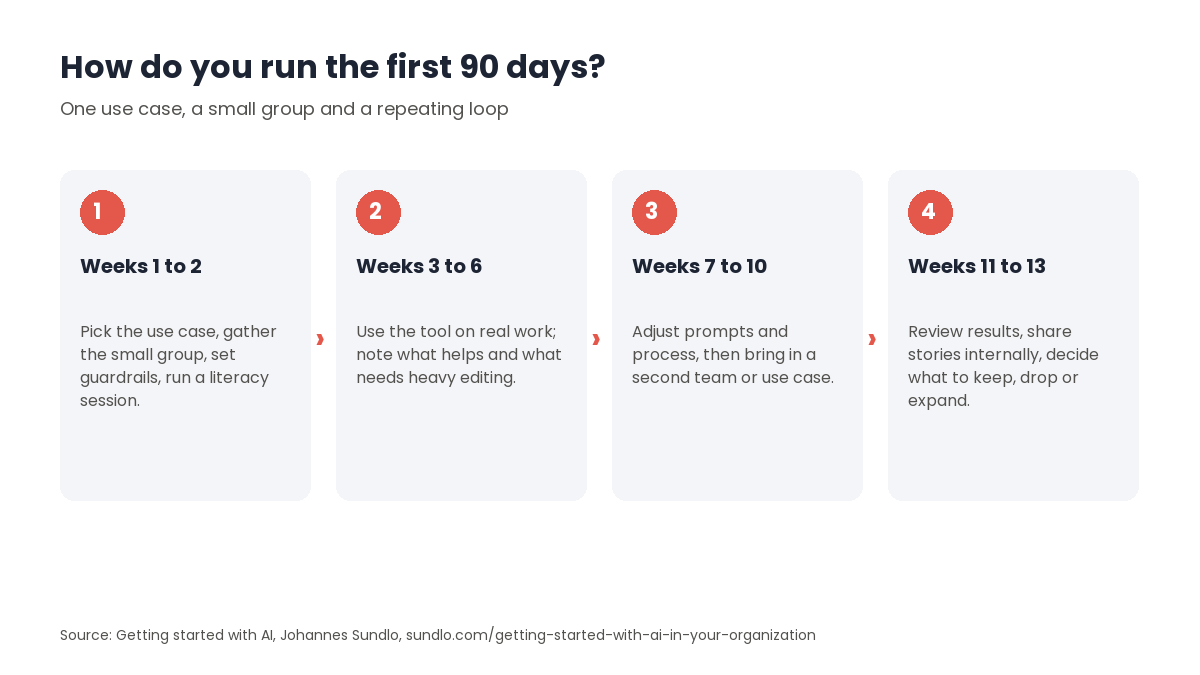
- Weeks 1 to 2: Pick the use case, gather the small group, set guardrails, and run a short literacy session.
- Weeks 3 to 6: Use the tool on real work. Capture what helps, what wastes time, and where output needs heavy editing.
- Weeks 7 to 10: Adjust prompts and process based on what you learned. Bring in a second team or a second use case.
- Weeks 11 to 13: Review results, share stories internally, and decide what to keep, drop, or expand.
Keep the group small enough that you can talk to everyone. The point of these ninety days is learning, not coverage. You are building an internal example you can point to, along with the habits and judgment to repeat it elsewhere.
Measure early wins honestly
You need evidence, but you do not need a sophisticated dashboard. Pick two or three signals that match your use case and track them lightly:
- Time saved on the specific task, estimated by the people doing it.
- How often people choose to use the tool when they could skip it.
- Quality of output after editing, judged by someone close to the work.
Be honest about the misses too. A tool that produces drafts nobody trusts is a finding, not a failure. Talk openly about what did not work and adjust it, instead of declaring victory and moving on. An early win matters mostly because it buys credibility for the next experiment.
What are the common traps to avoid?
- Boiling the ocean. Changing everything at once spreads attention too thin to learn anything from any of it.
- Skipping literacy. Handing people tools without context produces either fear or careless use.
- No owner. When the effort belongs to everyone, nobody chases the pilot when it stalls. Name a person.
- Measuring nothing. Without a few honest signals, you cannot tell progress from noise.
Getting started well looks undramatic from the outside: one real problem, a small capable group, clear guardrails, visible support from managers and an honest look at the results. Do that once and you have something a tool license never gives you, a repeatable way to bring AI into the work. For the wider picture of how this connects to strategy, change, and capability, see the AI adoption hub.
Sources
Make it useful for your team
Start with your real tasks, the tools you can use and what you want people to do afterwards.