The short answer
AI can help managers draft feedback, organise 360 comments and prepare for difficult conversations. It should not independently decide ratings, pay or promotions. The manager must check the evidence, notice missing context and own the final assessment. An AI summary is a draft to review, not a verdict about a person.
Read the full guide- Good uses Drafting, summarising and rehearsal.
- Human decisions Ratings, pay and promotions.
- Meaningful review Check the source, not just the summary.
Where does AI genuinely help in performance management?
The strongest use cases all share a trait: a human still owns the outcome. AI handles the heavy lifting on the inputs.
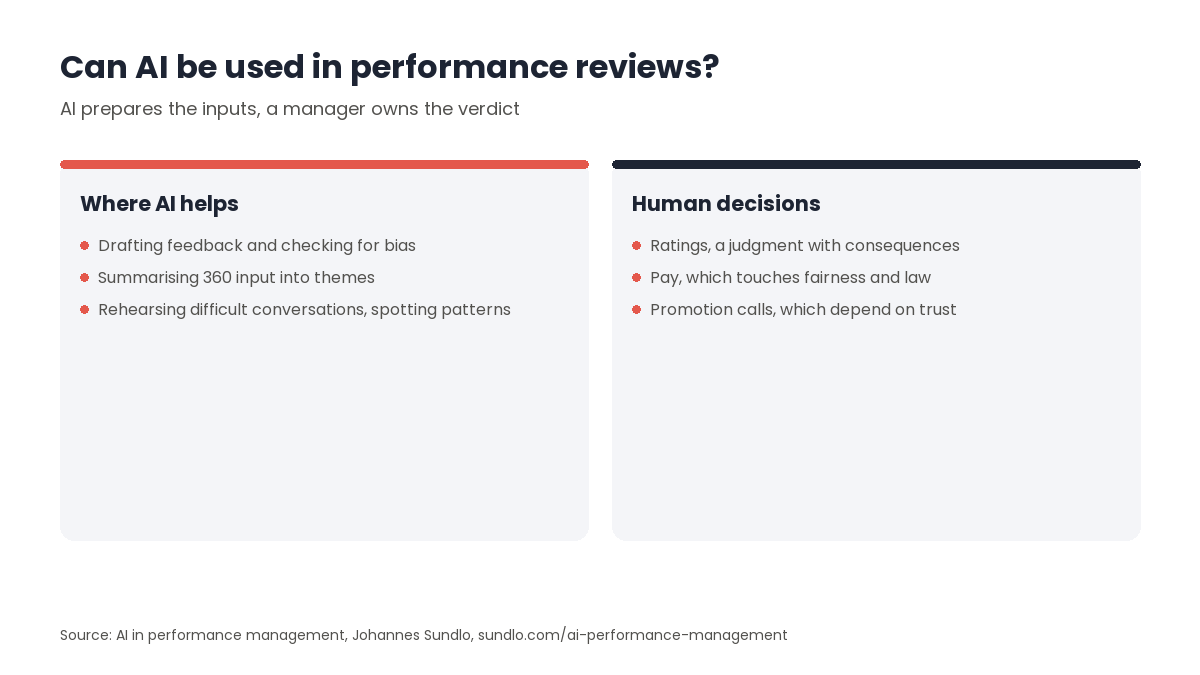
Drafting feedback and checking for bias
Managers often know what they want to say but struggle to say it cleanly. AI can turn rough notes into clear, specific feedback, then flag language that leans vague or loaded. Phrases like “not a culture fit” or “lacks executive presence” get caught and questioned, which nudges the manager toward observable behavior instead of impressions.
A simple prompt can do a lot of this work:
Here are my rough notes on an employee’s last quarter. Rewrite them as specific, behavior-based feedback. Flag any sentence that is vague, judgmental, or could carry bias, and suggest a more concrete version. Do not invent achievements I did not mention.
The point is to sharpen the message before it reaches a person, not to hand it over to a tool.
Summarizing 360 input
A round of 360 feedback can produce dozens of comments across many reviewers. Reading them fairly is hard, and tired managers skim. AI can group the comments into themes, separate signal from one-off remarks, and show where reviewers agree or contradict each other. The manager reads a structured summary, then goes back to the raw comments for anything that matters. That can make review more manageable, but it is not automatically fairer. Check that the summary represents the original comments and does not erase minority views.
Prepping for tough conversations
Difficult conversations go badly when managers walk in unprepared. AI can act as a rehearsal partner: draft an opening, anticipate how the employee might respond, and suggest how to keep the conversation factual rather than personal. It can also help a manager check their own framing before they speak. None of this scripts the meeting, but it lowers the odds of a clumsy opening line.
Spotting patterns
Across a team or a year, useful signals hide in plain sight. One person’s feedback quietly drifting downward. Goals that keep slipping for structural reasons rather than individual ones. Review language that reads differently for different groups. AI can surface these patterns for a manager to look into, and a pattern is a question, not a verdict.
If you want more grounding on these working patterns, my broader notes on AI for HR and our collection of ChatGPT prompts for HR cover the practical mechanics in more depth.
Can AI be used in performance reviews?
Can AI be used in performance reviews? Yes, for preparation, not for verdicts: AI can draft feedback from a manager’s rough notes, group dozens of 360 comments into themes, rehearse a difficult conversation and surface patterns such as one person’s feedback drifting downward. It should not decide ratings, pay or promotions on its own, because those are judgments that carry consequences and need an accountable human. Legally, the EU AI Act classifies systems used in employment and worker management as high-risk under Annex III. A real human in the loop means a named person reviews every AI-assisted output before it reaches an employee, sees what the AI was given, and knows the model can be wrong or flatten nuance. Introduce it with one tightly scoped drafting use case, a pilot with a few willing managers, a one-page note on what AI is and is not used for, and open communication with employees. Expand only once the first use case is trusted.
See also the free AI course for HR and the comparison of AI courses for HR professionals.
What AI should not decide on its own
There is a short list of decisions that AI should never make alone, no matter how confident the output sounds.
- Ratings. A model can summarize evidence, but the rating is a judgment that carries consequences. It belongs to a manager who can be held accountable for it.
- Pay. Compensation decisions touch fairness, equity and law. They need human deliberation, context the model cannot see, and a clear record of who decided and why.
- Promotion calls. Readiness for a bigger role depends on potential, trust and team context. These are exactly the things AI estimates poorly and humans must own.
There is also a practical reason beyond principle. In several regions, automated decisions that significantly affect someone’s work or pay carry legal obligations around transparency and human review. Treating AI as a decision-maker for ratings, pay or promotions invites risk that a drafting tool simply does not.
What decisions should AI never make in performance management?
What decisions should AI never make in performance management? AI should never make ratings, pay or promotion decisions on its own, no matter how confident the output sounds. A rating is a judgment that carries consequences and belongs to a manager who can be held accountable for it. Pay touches fairness, equity and law, and needs human deliberation plus a clear record of who decided and why. Promotion calls depend on potential, trust and team context, exactly the things AI estimates poorly. In several regions, automated decisions that significantly affect someone’s work or pay also carry legal obligations around transparency and human review. The review has to be real; if a manager approves AI output without reading it, you have automated the decision in everything but name. In my State of AI in HR survey, 47% of organisations have an AI policy, so write the one-page note on what AI is and is not used for before the first review cycle.
Keeping a human in the loop
“Human in the loop” is easy to say and easy to fake. A real version has a few practical requirements:
- A named person reviews every AI-assisted output before it reaches an employee. Review is the default, not the exception.
- The reviewer can see what the AI was given, so they can judge whether the summary is fair to the source.
- Managers are told plainly that AI can be wrong, can flatten nuance, and can carry the biases of its training. Skepticism is part of the job, not a sign of resistance.
- Sensitive personal data is handled with care, and you know where employee information goes when it enters a tool.
The goal is to make the human review meaningful rather than a rubber stamp. If a manager approves AI output without reading it, you have automated the decision in everything but name.
What is a practical way to introduce AI in performance management?
Most failed rollouts start too big. A calmer path looks like this.
- Start with one tightly scoped drafting use case. Drafting feedback or summarizing 360 input are good first steps because a human still writes the final version. Leave ratings, pay and promotions untouched.
- Pilot with a few willing managers. Pick people who will give honest feedback, not just enthusiasts. Run it for a review cycle and ask what helped and what felt off.
- Write down what AI is and is not used for. A one-page note is enough. Clarity here prevents quiet scope creep into decisions it should not touch.
- Be open with employees. Tell people that AI helps managers prepare feedback and that a human writes and owns every assessment. People accept a tool they were told about and resent one they discover later.
- Review the outputs, not just the tool. After the pilot, read a sample of the actual feedback. Did it get clearer? Fairer? Or just longer? Adjust based on what you see.
Expand only once the first use case is genuinely working and trusted. The pace should be set by quality, not by the calendar.
The honest summary
AI in performance management works best as a thinking aid, not a verdict machine: it drafts, summarises, surfaces and rehearses, and people decide. If you keep that division clear, you get better-prepared managers, fairer feedback and more time for the conversations that matter. If you blur it, you get a confident tool making decisions that no one wants to defend when the employee asks who decided.
Sources
Make it useful for your team
Start with your real tasks, the tools you can use and what you want people to do afterwards.