The short answer
AI can help structure survey comments, explore workforce patterns and compare planning scenarios. It does not turn weak data into reliable evidence or prove why people leave. Use appropriate, access-controlled data, check calculations and themes against the source, and treat patterns as questions for investigation.
Read the full guide- Useful for Survey themes, scenarios and analytical drafts.
- Not proof A correlation does not establish a cause.
- Check the source Validate numbers, samples and interpretation.
What does AI change in people analytics?
HR data is usually messy. It lives in an HRIS, a payroll system, a survey tool, an applicant tracking system and a handful of spreadsheets that someone maintains by hand. Different names for the same job title. Inconsistent date formats. Free-text fields where a manager wrote whatever felt right at the time. Historically, most of the effort went into reconciling all of this before any analysis could begin.
AI helps in three practical ways:
- Turning messy data into something usable. Language models are good at reading inconsistent text, matching records that refer to the same thing and flagging gaps. They can map free-text reasons for leaving into a consistent set of categories, or summarise hundreds of open survey comments into themes you can read in a few minutes.
- Surfacing drivers rather than just numbers. A traditional dashboard tells you attrition rose to nine percent. A model can help you see which factors move alongside that rise: tenure bands, specific managers, commute distance, time since last promotion. It does not prove cause, but it points you toward the questions worth asking.
- Making analysis conversational. Instead of waiting for a report, an HR business partner can ask a plain question and get a draft answer with the underlying figures attached. That lowers the barrier for people who are not analysts but still need evidence.
None of this removes the need for judgement. It shifts where your time goes, from preparing data to interpreting it.
How can HR use AI in people analytics?
How can HR use AI in people analytics? AI helps in three practical ways: it turns messy HR data into something usable, mapping free-text leaving reasons into consistent categories or summarising hundreds of survey comments into themes; it shows which factors move alongside a number, such as tenure bands or time since last promotion when attrition rises; and it makes analysis conversational: a plain question gets a draft answer with the figures attached. Realistic use cases: attrition and engagement analysis, scenario-based workforce planning, a first-draft skills inventory. It does not turn weak data into evidence, and correlation does not prove cause. Employee data is personal data under GDPR, so aggregate where you can and keep a human in the loop on decisions about careers or pay. In my State of AI in HR survey, lack of technical skills (41%) and time (41%) are the biggest barriers, so start with one concrete question and trusted data, not a platform purchase.
See also the free AI course for HR and the comparison of AI courses for HR professionals.
Realistic use cases
It helps to be specific about what is genuinely useful today, rather than what sounds impressive in a vendor deck.
Understanding attrition and engagement
You can feed historical data into a model and ask which patterns are associated with people leaving. The output is a set of signals, not a verdict. Maybe regrettable attrition clusters in one function, or among people who have not had a development conversation in over a year. That gives you a place to investigate and a hypothesis to test with managers who know the context.
The same approach works for engagement survey data. AI can group thousands of comments into recurring themes, show how sentiment differs across teams, and highlight where positive scores hide a vocal minority. You still read the raw comments. The model just helps you decide which ones to read first.
Scenario-based workforce planning
Workforce planning is where this becomes interesting for leaders. Rather than a single static headcount forecast, you can model several futures. What happens to capacity if attrition stays flat versus rising two points? How does a hiring freeze in one region ripple through delivery? What skills will be short if a product line grows as planned?
AI does not predict the future here. It helps you build and compare scenarios quickly, so the conversation with finance and the business is grounded in numbers rather than assertions. The value is in the speed of iteration, letting you ask “what if” ten times instead of once.
Closing skills gaps
Many organisations have no reliable picture of the skills they hold. AI can read job descriptions, project records and learning data to draft a skills inventory, then compare it against what upcoming work will require. Treat the first draft as a starting point to correct, not a finished map.
The cautions that matter
This is the part that deserves more attention than it usually gets. People analytics deals with information about real people, and the cost of getting it wrong is higher than in most other applications of AI.
- Data quality decides everything. A model trained on biased or incomplete history will reproduce that bias with a confident tone. If your past promotion data favoured one group, a model that learns from it will quietly recommend more of the same. Cleaning the inputs and labelling them honestly is most of the work, and there is no shortcut past it.
- Privacy is not optional. Employee data is personal data. Under GDPR and similar regimes, you need a lawful basis, clear purpose limitation and transparency about what you analyse and why. Aggregate where you can. Avoid building individual risk scores that managers might act on without context.
- Correlation is not cause. A model showing that people who skip a benefit tend to leave does not mean the benefit retains them. Acting on correlation as if it were cause is one of the easier ways to waste money and trust.
- Keep a human in the loop. Decisions that affect someone’s career, pay or job should never rest on a model’s output alone. Use AI to inform the conversation, not to make the call.
If you want a wider view of where the field stands and how peers are handling these questions, the state of AI in HR is a useful reference point.
Can AI predict which employees will leave?
Can AI predict which employees will leave? Not as a verdict about a person; AI can show which patterns in your historical data are associated with people leaving, and those patterns are hypotheses to test, not predictions to act on. Regrettable attrition might cluster in one function, or among people who have not had a development conversation in over a year; that is a place to investigate with managers who know the context. Correlation is not cause: if people who skip a benefit tend to leave, that does not mean the benefit retains them. Data quality decides everything: a model trained on biased history reproduces that bias with a confident tone. And employee data is personal data under GDPR, so aggregate where you can and avoid individual risk scores. In my State of AI in HR survey, 30% of Swedish HR professionals cite legal or ethical concerns as a barrier. Keep a human in the loop on any decision about someone’s career, pay or job.
How do you start small with AI in people analytics?
The teams that get value from this rarely begin with a platform purchase. They begin with one question that matters and data they already trust.
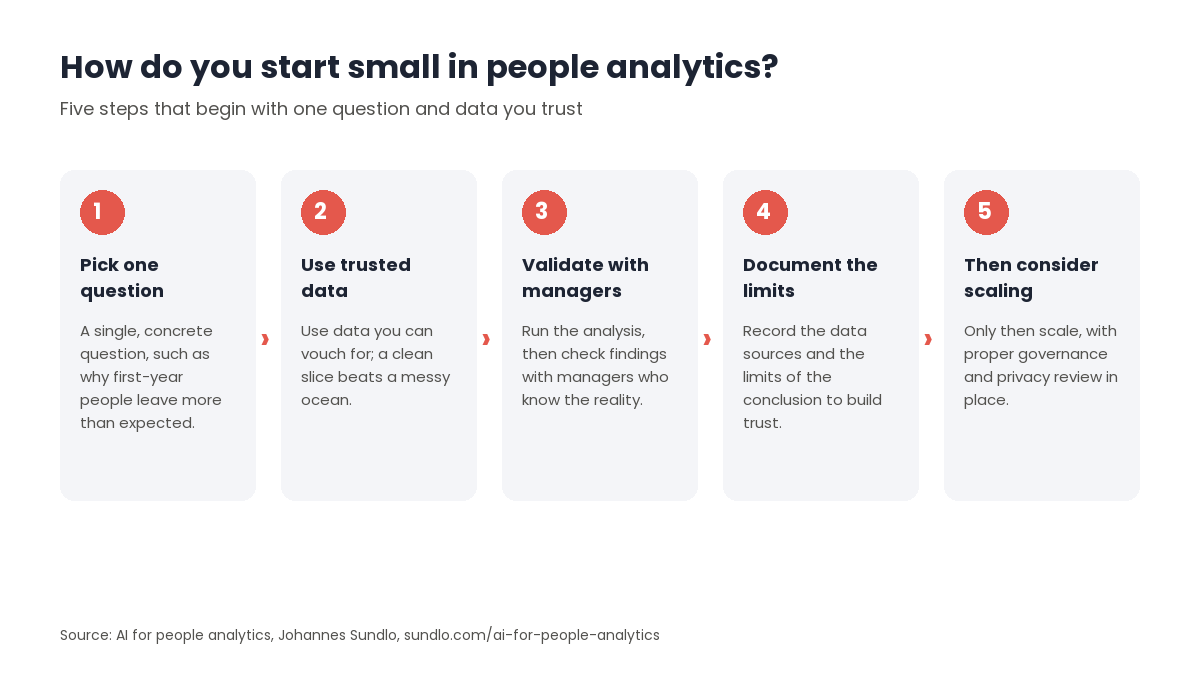
- Pick a single, concrete question. For example: why are people in their first year leaving more than expected?
- Use data you can vouch for, even if it is narrow. A clean slice beats a messy ocean.
- Run the analysis, then validate the findings with managers who know the reality on the ground. Their reaction tells you whether the signal is real.
- Document what you did, including the data sources and the limits of the conclusion. This builds the trust you will need for the next, bigger question.
- Only then consider scaling, with proper governance and privacy review in place.
Starting small also protects you. A narrow first project surfaces your data problems and your governance gaps while the stakes are low, which is far better than discovering them in a board-level workforce plan.
People analytics with AI is less about predicting people and more about asking better questions, faster, with the evidence to back them up. The judgement stays with you. The reconciling and sorting can go to the model. If you are building out broader capability, it sits naturally alongside the rest of your AI for HR efforts rather than as a separate project.
Sources
- GDPR, Article 5: Principles relating to processing of personal data (2016)
- IMY (Swedish Authority for Privacy Protection), Personal data
- IMY, Rättslig grund: personuppgifter i arbetslivet (in Swedish)
- GDPR, Article 22: Automated individual decision-making, including profiling (2016)
- Johannes Sundlo, State of AI in HR (2025)
Make it useful for your team
Start with your real tasks, the tools you can use and what you want people to do afterwards.