The short answer
There is no single best AI tool for every HR team. Start with the approved workspace you already have, then compare tools on your own drafting, analysis or document tasks. The useful choice depends on output quality, integrations, access controls and cost, not just a model's benchmark score.
Read the full guide- Start with approval Check the plan and data settings with your organisation.
- Test real work Use the same task and review criteria.
- Compare the whole tool Models, files, integrations and permissions.
Which four AI models do HR teams meet?
Most HR professionals will run into the same four families. How they are built matters less than how they behave when you hand them a job ad, a survey export or a policy draft.
- ChatGPT (OpenAI): the most widely used and the easiest to start with. Strong all-rounder for drafting, brainstorming and quick rewrites. Large ecosystem, lots of integrations, and the version most of your colleagues will already recognize.
- Claude (Anthropic): often preferred for longer writing, careful summarizing and work where tone and nuance matter. Many HR users find its drafts need less heavy editing for sensitive topics.
- Gemini (Google): sits close to Google Workspace, so it is a natural fit if your team lives in Docs, Sheets and Gmail. Handy for pulling things together across documents.
- Copilot (Microsoft): built into the Microsoft 365 world. If your HR data and daily work already sit in Outlook, Word, Teams and SharePoint, Copilot sits inside those tools and can reference your own documents.
If any of these terms are new, the AI dictionary for HR explains them in plain language.
Which AI model is best for HR?
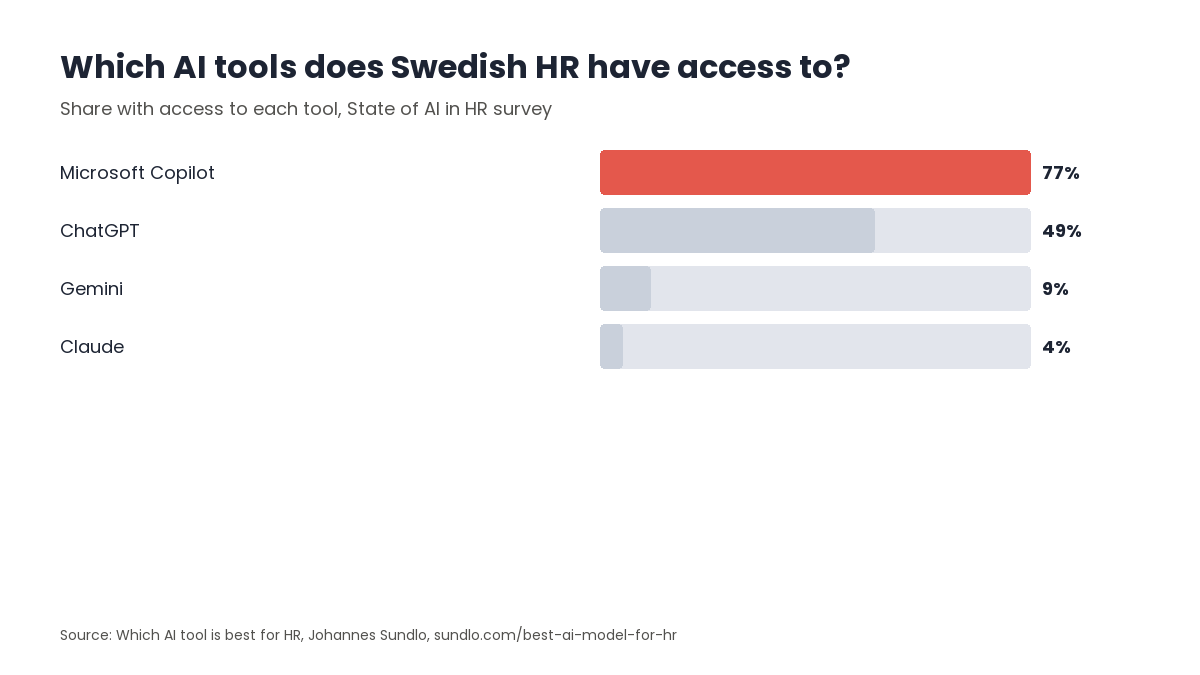
Which AI model is best for HR? There is no single best AI model for HR; the right choice is the tool your organisation has approved, configured for the right privacy tier, and that you have learned to prompt well. Most HR teams meet four families: ChatGPT (OpenAI), the most widely used all-rounder; Claude (Anthropic), often preferred for longer writing and sensitive topics where tone matters; Gemini (Google), a natural fit for teams living in Docs, Sheets and Gmail; and Copilot (Microsoft), built into Microsoft 365 and able to reference your own documents. The differences are smaller than the marketing suggests, and a clear prompt on an average model beats a lazy prompt on the best one. In my State of AI in HR survey of Swedish HR professionals, 77% have access to Microsoft Copilot, 49% to ChatGPT, 9% to Gemini and 4% to Claude. Free consumer accounts are not built for employee data; use business or enterprise tiers for anything sensitive.
See also the free AI course for HR and the comparison of AI courses for HR professionals.
How they compare for common HR tasks
Rather than rank the models overall, it helps to look at the kinds of work HR does every week. The differences are smaller than the marketing suggests, but they are real.
Writing and rewriting
Job ads, policy drafts, internal announcements, feedback notes. All four handle this well. Claude tends to produce calmer, more human prose with less of the obvious AI cadence, which matters for anything an employee will read. ChatGPT is fast and flexible and gives you plenty of variations to choose from. For writing that lives inside a Word document already, Copilot saves you the copy and paste.
Summarizing
Long engagement surveys, meeting notes, exit interview transcripts, policy documents. This is where the newer models genuinely shine. They can take a wall of text and give you the themes, the outliers and a short summary you can share. Claude and Gemini both handle large amounts of text comfortably. Copilot has the advantage of summarizing the meeting you just had in Teams without you doing anything.
Analysis and pattern spotting
Turnover trends, survey results, spotting themes in open text answers. The models can do a lot here, but treat the output as a first read, not a finding. They are good at surfacing patterns and bad at knowing your context. Always sanity check the numbers yourself.
Reasoning through a messy problem
Thinking through a tricky employee relations situation, weighing options for a reorganization, structuring a decision. The stronger reasoning modes in ChatGPT, Claude and Gemini are useful as a thinking partner. They will ask questions you forgot and lay out trade-offs. They will not, and should not, make the call for you.
A simple framework: start from the task
Instead of picking one model and forcing every task through it, start from what you are trying to do.
- Need it to sound human and considerate? Reach for the model that gives you the cleanest draft to edit. Many HR users land on Claude here.
- Need speed, options and a familiar interface? ChatGPT is hard to beat as a default.
- Living inside Google all day? Gemini removes friction.
- Living inside Microsoft 365 with sensitive data? Copilot keeps the work where your security team already has control.
This is not a permanent ranking, since the models leapfrog each other constantly. The point of the framework is that you do not have to keep score, only match the task to whatever does it well today.
Why does the model matter less than how you use it?
The comparison charts leave this part out. The gap between a good prompt on an average model and a lazy prompt on the best model is far larger than the gap between the models themselves. A clear request, with context, examples and a defined audience, beats model choice almost every time.
If you want to get more out of whichever tool you settle on, a small set of reliable prompts will take you further than switching apps. Our collection of ChatGPT prompts for HR works just as well in Claude, Gemini or Copilot, because the skill is in the instruction, not the logo.
The part HR cannot skip: data and privacy
For HR, which model writes the nicest job ad comes second. The first question is what happens to the data you put in. HR handles personal information, performance notes, health-related details and salary data. That changes the rules.
A few principles to hold onto:
- Free consumer accounts are not built for HR data. Treat them as you would a public notepad. Useful for general drafting and learning, not for real employee information.
- Enterprise and business tiers are different. The paid business versions of these tools typically commit to not training on your inputs and offer stronger data controls. That is the tier HR should be using for anything sensitive.
- Check where your data sits. Data location, retention and processing terms matter under GDPR. This is a conversation to have with IT and your data protection lead, not a setting to guess at.
- The tool you already pay for is often the safest answer. If your organization runs Microsoft 365 or Google Workspace, the built-in AI inherits agreements your security team has already reviewed. That can outweigh a slightly better model elsewhere.
None of this means HR should avoid AI. Choose the tier and the setup that let you use it responsibly, and then use it. The best AI model for HR is the one your organization has approved, configured for the right privacy tier, and that you have learned to prompt well.
Can HR use free AI accounts with employee data?
Can HR use free AI accounts with employee data? No. Free consumer accounts are not built for HR data; treat them as a public notepad, fine for general drafting but not for personal information, performance notes, health details or salary data. Business and enterprise tiers typically commit to not training on your inputs and offer stronger data controls; that is the tier for anything sensitive. Check data location, retention and processing terms, which matter under GDPR, with IT and your data protection lead rather than guessing. The tool you already pay for is often the safest answer: Microsoft 365 or Google Workspace AI inherits agreements your security team has already reviewed, which can outweigh a slightly better model elsewhere. Policy is catching up: in my State of AI in HR survey, 47% of Swedish organisations have an AI policy, up from 27% in 2024. A business label still does not replace a review of data handling, permissions and configuration.
So which one should you pick?
Start with the tool your organisation has already approved and one defined use case. Compare the outputs against your own criteria, including accuracy and how much editing they need. I would not let a business or enterprise label stand in for a review of data handling, permissions and configuration.
Sources
- Johannes Sundlo, State of AI in HR (2025)
- Microsoft Learn, Microsoft 365 Copilot overview
- Microsoft Learn, Data, privacy, and security for Microsoft 365 Copilot
- Google Workspace Help, How Gemini in Gmail, Docs, Sheets and other apps protects your data
- Anthropic Privacy Center, Is my data used for model training?
Make it useful for your team
Start with your real tasks, the tools you can use and what you want people to do afterwards.