The short answer
A skills-based organisation uses demonstrated capabilities, not only job titles, to match people with work and development opportunities. You do not need to remove every role or build a complete skills taxonomy first. Start with one project or talent process, define the skills it needs and validate the information with people.
Read the full guide- The shift From titles alone to evidence of capability.
- Start small One project or internal opportunity.
- Keep people involved Validate skills rather than trusting AI inference.
What is a skills-based organization?
In a traditional structure, the job is the unit of work. You write a job description, you hire a person to fill it, and that person owns a fixed bundle of tasks until the role changes. Skills sit somewhere underneath, mostly invisible.
A skills-based organization flips the order. The skill becomes the primary unit. Work is broken into tasks and projects, and you match people to that work based on the skills it requires and the skills they have, whether or not those skills appear in their formal title. The job still exists, but it stops being the only lens through which you see a person.
In practice this shows up in a few concrete ways:
- A finance analyst with strong data skills joins a marketing project for a quarter, because the project needs that skill and she has it.
- Internal openings are described by the skills they require, not only by a department and a level.
- Development conversations start from the skills a person wants to build, and the organization points them toward real work where they can build them.

How do you start a skills-based organization?
How do you start a skills-based organization? Start with one area and one real decision, not a company-wide taxonomy. A skills-based organization matches people to work on demonstrated capabilities rather than job titles alone, so a finance analyst with strong data skills can join a marketing project for a quarter. The practical first steps: pick one function where flexible staffing already matters; agree a short shared skills vocabulary (a rough list of fifty beats a perfect five hundred); ask managers and employees to map current skills against it; then use it for one real decision, such as staffing a project. The common pitfalls are a giant taxonomy first, skills data nobody keeps fresh and managers who hoard talent. AI makes the data side realistic by inferring skills from project history, matching people to open work and flagging stale records. The EU AI Act classifies AI in employment and worker management as high-risk under Annex III, so a human confirms every decision about someone’s opportunities.
See also the free AI course for HR and the comparison of AI courses for HR professionals.
Why it is rising now
Skills-based thinking is not new; what has changed is the pressure on the old model, and it comes from three directions.
Work is changing faster than job descriptions
Most job descriptions are written once and quietly go stale. When the work shifts every few months, a document that took weeks to negotiate cannot keep up. Tracking skills, which are smaller and more fluid, gives you a more honest picture of what your people can do right now.
AI is reshaping the task mix inside roles
AI is not erasing whole jobs so much as redistributing the tasks inside them. A role can lose half its routine work to automation and gain new work that did not exist a year ago. When that happens, the title stays the same while the skill requirements move underneath it. A skills view lets you see that movement instead of being surprised by it. (For a wider look at where this lands, see my notes on AI for HR.)
Internal mobility has become a retention question
People leave when they cannot grow where they are. A skills-based approach makes internal moves visible and normal, because you can see who has adjacent skills and who is ready to stretch. It turns mobility from a once-a-year event into something that can happen whenever the work and the person line up.
How does it differ from role-based structures?
The difference is easier to feel than to define, so here is a side-by-side view of the same decisions made two ways.
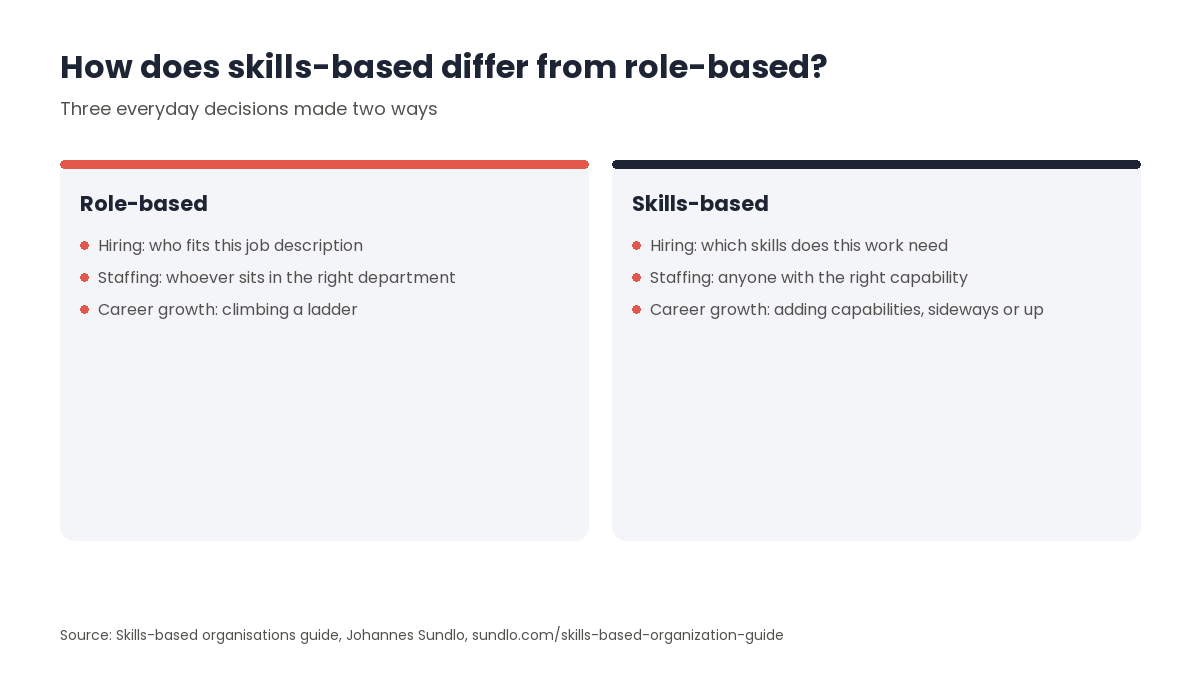
- Hiring: a role-based org asks “who fits this job description.” A skills-based org asks “which skills does this work need, and who has or can build them.”
- Staffing projects: role-based staffing pulls from whoever sits in the right department. Skills-based staffing pulls from anyone with the right capability.
- Career growth: role-based growth means climbing a ladder. Skills-based growth means adding capabilities, which can move you sideways, into new domains, or up.
- Workforce planning: role-based planning counts headcount by box. Skills-based planning counts the skills you have against the skills you will need.
None of this means titles disappear. People still need a sense of where they belong. The point is that the title becomes one signal among several, rather than the only one that decides what a person is allowed to do.
Practical first steps
You do not need a platform purchase or a reorganization to begin. Start small and let the approach earn its place.
- Pick one area, not the whole company. Choose a function or a project type where flexible staffing already matters, and learn there first.
- Build a simple skills vocabulary. Agree on a short, shared list of skills that matter for that area. A messy list of fifty beats a perfect list of five hundred that nobody maintains.
- Capture what people already have. Ask managers and employees to map current skills against that vocabulary. Accept that the first version will be rough.
- Use it for one real decision. Staff a project, fill an internal opening, or plan one development path using skills as the deciding factor. A single concrete win does more to convince people than any slide.
- Connect it to recruiting. Write at least one opening around the skills the work needs rather than a long list of nice-to-haves. My notes on AI in recruiting cover how this changes sourcing and screening.
Common pitfalls
Most failures here are predictable, which means they are avoidable.
- Building a giant taxonomy first. Teams spend months perfecting a skills library and never use it. Start with a rough list and improve it through use.
- Treating it as a one-time data project. Skills go out of date. If nothing keeps the data fresh, it decays within a year and people stop trusting it.
- Forgetting the manager. If managers are not rewarded for sharing talent across boundaries, they will hoard it, and the model quietly dies.
- Confusing skills with proficiency. Knowing that someone has a skill is not the same as knowing how good they are at it. Decide early how you will capture level, even if it is just self-rating plus a manager check.
- Letting it become surveillance. If people feel skills data is used against them, they will game it. Be clear that the point is opportunity, not scoring.
How does AI help build a skills-based organization?
How does AI help build a skills-based organization? AI helps in three ways: it infers likely skills from the work people already do, it matches people to open projects and it flags skill records that look stale. Instead of asking everyone to fill in a form, the model reads project history, internal documents and completed tasks, and humans confirm or correct. Matching surfaces people with the right or adjacent skills, which is often where internal mobility comes from. Flagging stale records tackles the decay that kills most skills initiatives. The data has always been the biggest practical barrier, and this is what makes the model realistic. Let AI do the heavy lifting on inference and matching, and keep a human in the loop on any decision that affects a person’s opportunities. In my State of AI in HR survey, 77% of Swedish HR professionals plan to expand AI in HR, and skills data is a good place to do it.
Where AI genuinely helps
The biggest practical barrier to a skills-based organization has always been the data. Mapping skills by hand is slow, and it goes stale the moment you finish. This is where AI is making the model realistic for organizations that could not attempt it before.
- Skills inference. Instead of asking everyone to fill in a form, AI can infer likely skills from the work people already do: project history, internal documents, completed tasks. Humans then confirm or correct, which is far faster than starting from a blank page.
- Matching. When you have an open project and a pool of people, AI can surface candidates with the right or adjacent skills, including people no manager would have thought to suggest. That is often where internal mobility comes from.
- Keeping data current. AI can flag where skill records look stale and prompt a quick refresh, which addresses the decay problem that kills most skills initiatives.
A sensible rule: let AI do the heavy lifting on inference and matching, and keep a person in the loop on any decision that affects someone’s opportunities. The technology widens the view of who could do the work; a manager still makes the call.
A skills-based organization is a way of seeing your workforce that you build up gradually, one decision and one area at a time, rather than a destination you arrive at in one quarter. The teams that start small, keep the data honest, and use AI to remove the manual grind tend to get there. The ones that start with a company-wide taxonomy usually stall on it.
Sources
Make it useful for your team
Start with your real tasks, the tools you can use and what you want people to do afterwards.