Talent teams should use AI in recruiting to draft and structure, never to decide or auto-reject. It helps most with job ads, interview guides, application summaries and interview scorecards. A job ad that took 60 to 90 minutes becomes 20 minutes of editing. Start with one high-frequency task and a one-page rule for candidate data.
By Johannes Sundlo, AI & Future of Work Advisor. I help leaders and HR teams turn AI into adoption that sticks, through keynotes, workshops and change programs.
Recruiting is one of the fastest places to get value from AI, and one of the easiest to get wrong. Used well, it removes hours of repetitive work and sharpens your decisions. Used carelessly, it bakes in bias and costs you candidate trust. Below I go through where the line goes and how to stay on the right side of it.
Where does AI genuinely help in recruiting?
- Drafting: first-draft job ads in your voice, outreach messages, structured interview guides tied to the role’s criteria.
- Screening support: summarising long free-text applications and comparing candidates against your stated criteria, as input, never the final call.
- Faster admin: scheduling copy, interview-note summaries, turning a debrief into a structured scorecard.
- Sourcing research: summarising a market or role, drafting boolean searches, prepping talking points.
Where does AI backfire in recruiting?
- Automated rejection. Never let a model auto-reject candidates. Use it to surface and structure, not to decide.
- Hidden bias. AI can amplify patterns in historical data. Keep humans accountable for every decision and check outcomes for disparity.
- Generic, soulless output. A job ad that reads like every other AI job ad repels good people. Always edit for your voice and specifics.
- Candidate-data risk. Be deliberate about what personal data goes into which tool, and tell candidates how AI is used.
How should talent teams use AI in recruiting?
How should talent teams use AI in recruiting? Use AI to draft and structure, never to decide or auto-reject. In my workshops with talent teams, AI helps most with first-draft job ads in your own voice, structured interview guides, summarising long applications against your stated criteria, and turning interview notes into scorecards. It backfires when a model auto-rejects candidates, amplifies bias from historical data, produces generic copy, or when sensitive candidate data is pasted into public tools. Start with one high-frequency task, build a reusable prompt with your tone and criteria, keep a recruiter deciding on every output, write a one-page rule for candidate data, and measure time saved and shortlist quality. A job ad that took 60 to 90 minutes becomes 20 minutes of editing, roughly a working day back each month for a team publishing ten ads. Regulation reinforces this: the EU AI Act can apply to recruitment systems, and NYC Local Law 144 applies to certain automated employment decision tools. Check the scope and current requirements for your use.
See also the free AI course for HR and the comparison of AI courses for HR professionals.
How do you introduce AI into hiring?
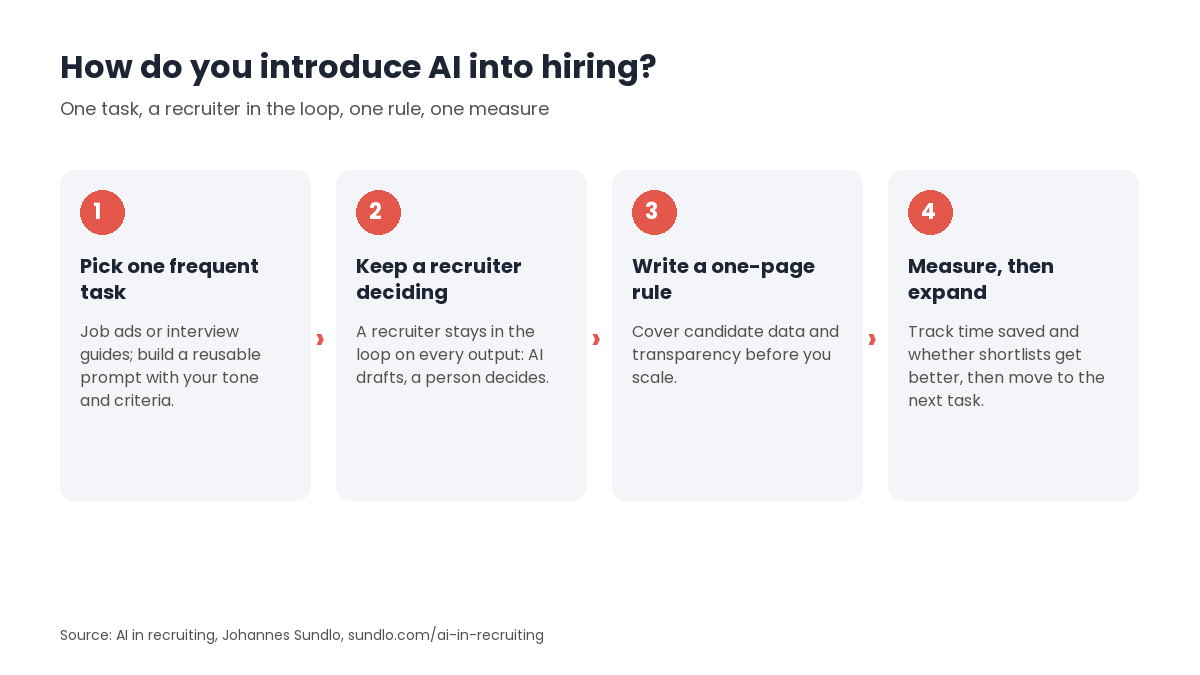
- Pick one high-frequency task (job ads or interview guides) and build a reusable prompt with your tone and criteria.
- Keep a recruiter in the loop on every output: AI drafts, a person decides.
- Write down a one-page rule for candidate data and transparency before you scale.
- Measure time saved and quality (do shortlists get better?), then expand to the next task.
What do the EU AI Act and NYC Local Law 144 require?
Requirements depend on the system, its intended use and the jurisdiction. Check the scope and current transition rules in the relevant authorities’ guidance.
- EU AI Act. Certain AI systems used for recruitment, selection and candidate evaluation fall within the high-risk categories in Annex III. Assess the system’s intended purpose, your role and any applicable exceptions before determining the requirements. Check current application dates in the European Commission’s guidance.
- NYC Local Law 144. applies to certain automated employment decision tools used for hiring or promotion in New York City. Tools within scope require an independent bias audit within the preceding year, public information about the audit and notices to affected candidates or employees.
- Check the rules where you recruit. Other jurisdictions have their own rules for AI in recruitment. Identify which apply to your use before introducing a new tool.
Map where AI is used in your recruitment process. Ask vendors for documentation of intended use, tests and limitations. Assign responsibility for assessments and decide how candidates will be informed. Have your legal or data-protection team assess the applicable requirements.
What should you check before using AI in hiring?
What should you check before using AI in hiring? Map where AI is used, which data it processes and who reviews outputs. Ask vendors for documentation of tests, limitations and intended use. Decide how candidates will be informed. Check the scope and current application dates of the EU AI Act and local rules where you recruit. NYC Local Law 144 includes audit and notice requirements for certain automated employment decision tools. A checklist or a human final decision does not by itself establish compliance with every applicable requirement.
How does AI cut job-ad writing to a third of the time? A worked example
The pattern I see most often in workshops with talent teams: a recruiter spends 60 to 90 minutes on a job ad, staring at a blank page, borrowing from an old ad, then fixing the borrowed bias baked into it. With a reusable prompt that carries your tone of voice, the role’s actual success criteria and a “what we will not write” list, the first draft takes minutes and the recruiter spends 20 minutes editing instead of an hour writing. For a team publishing ten ads a month, that is roughly a working day back, every month, from one prompt. And the ads get better, because the editing time goes into specifics that attract the right applicants instead of into producing text.
The same logic applies down the funnel: structured interview guides from the criteria, debrief notes into scorecards, outreach that sounds like you. Which tools to do it with? Start with the ones you already have (Copilot, ChatGPT or Claude with your templates), then look at dedicated recruiting tools in the AI tools for HR list once the workflow is proven.
Common questions about AI in recruiting
Can AI screen candidates?
It can help summarise and structure applications against your criteria, but it should never make the final accept/reject decision. Keep a human accountable to avoid bias and legal risk.
Is it legal to use AI in hiring?
It depends on the use, the data processed and the applicable rules. Assess data protection, discrimination risks and any requirements for the AI system with your legal or data-protection team.
Does the EU AI Act apply to recruiting?
Certain AI systems for recruitment, selection and candidate assessment fall within the high-risk categories in Annex III. Assess the system’s intended use, your role and applicable exceptions. Check current application dates in the European Commission’s guidance.
Recruiting is one slice of a bigger shift. For the full picture, see AI for HR and the hub guide on AI adoption that sticks.
Bring practical AI to your talent team
In a workshop, your recruiters build working prompts for their own roles and agree how candidate data may be used. Tell me about your team.
AI in recruiting: where does it help and where does it backfire?
| Task | Where AI helps | Where it backfires |
|---|---|---|
| Job ads | First drafts in your voice | Generic, soulless copy |
| Screening | Summarise & structure as input | Auto-rejecting candidates |
| Decisions | Surface evidence for a human | Making the final call (bias & legal risk) |
| Candidate data | , | Pasting sensitive data into public tools |
The data behind this: see the State of AI in HR report, original survey data on the AI adoption gap.