The short answer
An AI agent can take several steps towards a task, such as finding information, navigating a website and preparing a result. My early Operator test showed both the potential and the need for supervision. For HR, start with low-risk tasks, limited access and a human approval before anything is sent or changed.
- The difference An agent acts across steps, not just answers.
- A sensible start Research and draft preparation using non-sensitive data.
- The boundary People approve consequential actions.
Hands-on review from 2025. Operator was an early product; names, plans and capabilities have since changed. The lessons below concern task design and supervision, not a current product benchmark.
ChatGPT Operator for HR
In January 2025 I got early access to ChatGPT Operator and tried it on real HR tasks. After more than a decade in HR, I came away both impressed and a little uneasy, and both reactions are worth explaining.
An agent that acts on your behalf is a different kind of tool from a chatbot that answers. If you want to know what that could mean for recruitment, workflows or whole roles, the test below is a useful place to start.
My Experience Using ChatGPT Operator for HR Tasks
Last week, I got access to ChatGPT Operator for HR and decided to try it out. It’s ChatGPT on steroids: it doesn’t just give you answers, it takes action, navigating tools like LinkedIn, handling spreadsheets, and even booking flights.
Here’s what happened when I gave it a spin:
I started simple, asking the Operator to search for HR Business Partners in Stockholm. It logged into LinkedIn, applied filters, evaluated profiles, and even showed me its reasoning along the way. Watching it navigate autonomously was surreal. Sure, it was a bit clunky and slow, but it worked.
Then I pushed further. Over the weekend, I tested it with more complex tasks:
- Creating a PowerPoint from scratch based on an uploaded document.
- Compiling articles into one shared file.
- Processing Excel data to cross-check numbers and find discrepancies.
- Researching and booking flights, with approvals needed along the way.
Every time, the Operator delivered. It’s not the fastest tool, but that doesn’t really matter. You can set it up with tasks, grab a coffee, and come back to find everything done.
This experience was both exciting and unsettling. It worked so well that I couldn’t help but wonder: What does this mean for the future of HR?
What can AI agents do for HR?
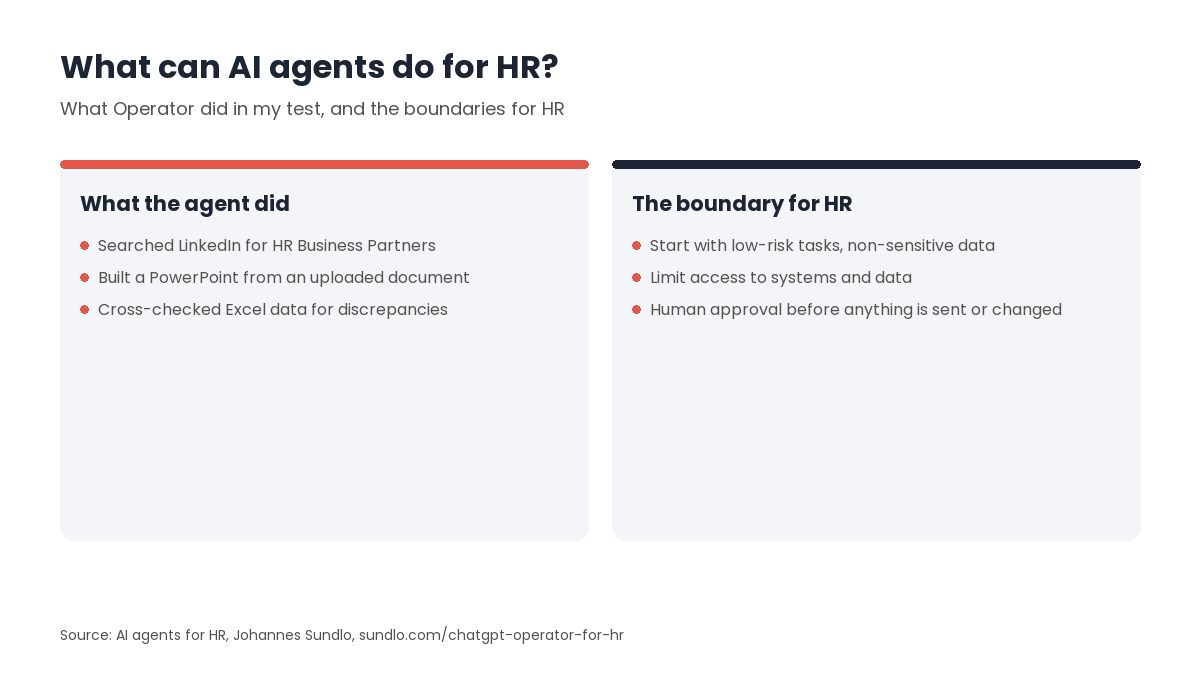
What can AI agents do for HR? An AI agent takes several steps towards a task on its own, finding information, navigating a website and preparing a result, rather than only answering a question. In my January 2025 test of ChatGPT Operator, it logged into LinkedIn to search for HR Business Partners in Stockholm, built a PowerPoint from an uploaded document, cross-checked Excel data for discrepancies and booked flights with approvals. The lessons hold even though Operator’s name, plans and capabilities have since changed: start with low-risk tasks, use non-sensitive data, limit access and keep a human approval before anything is sent or changed. AI systems used in employment, worker management and recruiting are classified as high-risk under Annex III of the EU AI Act, so candidate data needs extra care. Adoption is still early: in my State of AI in HR survey, only 25% of Swedish HR professionals use AI agents in their HR work.
See also the free AI course for HR and the comparison of AI courses for HR professionals.
Why ChatGPT Operator for HR Feels Like a Turning Point
The bigger point is that a tool like Operator does more than make existing work easier. It changes which parts of the work a person needs to do at all.
The broader lesson is that the cost and capability of AI tools can change quickly. Evaluate the workflow you need now rather than relying on a launch-era model comparison.
For those of us in HR, this raises big questions:
- How will our roles evolve as tools like this handle more of the repetitive, time-consuming tasks?
- What will HR look like in a world where AI can act independently?
- And perhaps most importantly, how do we stay ahead of these changes?
I do not have all the answers. I am sure that agents like this will change how HR work gets done, and that being ready beats being surprised.
How ChatGPT Operator for HR Can Help
For anyone wondering how ChatGPT Operator for HR fits into their daily work, here’s what it can already do:
- Recruitment: Sift through LinkedIn profiles, apply filters, and evaluate candidates.
- Data Management: Process spreadsheets, cross-check numbers, and find anomalies.
- Content Creation: Generate presentations, compile documents, and summarize large amounts of text.
- Task Automation: Research travel options, book tickets, or handle repetitive admin work.
And this is just the beginning. As the technology improves, the potential use cases will only grow.
Why HR Professionals Need to Act Now
Whether HR engages with AI is no longer an open question. The tools are already in use around us, and the longer a team waits to learn them, the more catching up it has to do.
I understand that AI can feel overwhelming, especially if you’re not a tech expert. But the good news is, you don’t have to figure this out alone. There are so many resources available:
- Free courses that build a solid foundation.
- Programs facilitated by myself or the free resources on FullStack HR.
- Webinars, blogs, and training sessions tailored for HR professionals.
Where you start matters less than picking one real, low-risk task and trying it this week.
Common Questions About ChatGPT Operator for HR
What is ChatGPT Operator for HR?
ChatGPT Operator is an advanced AI tool that automates tasks like recruitment, data analysis, and document creation. It mimics human actions in tools like LinkedIn, Excel, and more.
How can ChatGPT Operator help HR professionals?
It takes on parts of repetitive tasks, which frees time for work that needs judgment. From sourcing candidates to checking large datasets, an agent may help with parts of the process.
What are the limitations of ChatGPT Operator?
It’s not the fastest tool and still requires some human oversight for complex tasks. However, its ability to act independently is improving rapidly.
Pricing and access in this early review are historical. Check the provider’s current plan and capabilities before choosing an agent.
Is an AI agent suitable for HR data? Do not assume so. Check the approved tool, access scope, processing terms and the task with your organisation. Start with non-sensitive information and keep human approval before consequential actions.
Final Thoughts: This Is Just the Beginning
If you’re an HR professional, ChatGPT Operator for HR is something you need to pay attention to. It’s not perfect, but it’s here, and it’s already changing how we work.
HR work will look different from today, and I find that both exciting and a little unnerving. The useful response is to learn the tools on low-risk tasks now, so HR shapes how agents get used rather than reacting to it afterwards.
Have thoughts on this? Want me to test something specific with the Operator?
Let me know. I’d love to hear from you.
Sources
Make it useful for your team
Start with your real tasks, the tools you can use and what you want people to do afterwards.